By Stephen Satterly, II, American Clearinghouse on Educational Facilities, March 2013
At 12:35 p.m. on September 20, 2002, lightning and thunder were smashing outside of Clinton Young Elementary on the south side of Indianapolis. The walls rumbled, terrifying adults and kids alike. From the tornado’s northwest side came a metallic tearing sound, followed by screams. Cascades of water poured into the hall as ventilator covers were ripped from the roof. Then the power went out, invoking more panic and screaming. Soon, it was evident a tornado had directly hit the roof of Southport Middle School behind Clinton Young, and came within twenty-five yards of the elementary school.
Tornadoes are violent, unpredictable, and create massive damage in a short amount of time. Schools are the social and economic core of many communities. Beyond education, schools provide and spur employment. School facilities and activities provide an important social connection for an area. Loss of a school, to any disaster including a tornado, will have a tremendous impact on a community. A community’s most precious resource is its children. Since children spend a majority of their day in schools, ensuring the safety of school facilities is essential.
Understanding the nature of severe weather events, and knowing how extreme wind can affect buildings and structures, is central to mitigating the severity of such events. Good information, and the right preparation, can help create a sustainable school that is the centerpiece of a community’s survivability and recovery, instead of the focus of a community’s tragedy.
All Hazards Approach to Emergency Management
The Federal Emergency Management Agency (FEMA) and the United States Department of Education established guidelines for emergency planning for schools which call for a four-phase process; prevention/mitigation, preparedness, response, and recovery (US DOE, 2008). These guidelines provide a comprehensive, risk-based, template for dealing with all hazards a school may face.
Threat Assessment by Design
The first step in the All-Hazards approach is the identification of risk via a threat assessment. When planning for extreme wind events, an area’s history of wind hazards is essential to determine the threat potential and the requirements to meet that potential. Resources from FEMA’s, Wind Zones of the United States and Tornado Activity in the United States provide the historic data needed to identify the threat potential of high winds and tornadic activity for specific areas (FEMA, 2008). The southern Great Plains, the Ohio River Valley, and the Gulf Coast region in the south are prime areas for the occurrence of tornadoes, although they can happen almost anywhere.
Once the threat potential is determined, Chapter Six of “Wind Loads” from the American Society of Civil Engineer’s, Minimum Design Loads for Buildings and Other Structures can provide guidance to requirements for school structures (ASCE, 2006). However, there are many other practical issues that must also be considered.
For example, must the entire building be tornado-proof? What about other factors, like cost? How much do geography and the area demographics contribute to hazard, response and recovery issues? Many factors are just common sense, but others require some expertise to be identified and mitigated effectively. This expertise can be found through the use of vulnerability assessments such as ACEF’s Educational Facilities Vulnerability/Hazard Assessment Checklist and collaboration with local emergency management agencies, universities, and local engineering and architectural firms, as well as State Departments of Homeland Security and FEMA (ACEF, 2011).
Mitigation
For building designers, the most important part of the building guidelines is mitigation, which can reduce the loss of life and property. A Multihazard Mitigation Council study found that every dollar spent in mitigation could prevent $4 in the recovery, a fact that is very important to both patrons and insurance companies (MMC, 2005).
Sustainability, the new buzzword in building design, refers to a community’s ability to withstand and overcome disaster damage. The objective of emergency management is to mitigate hazards in a sustainable way to counter the increasing losses from natural hazards. Under the Robert T. Stafford Disaster Relief and Emergency Assistance Act of 1988, it is also a legal requirement.
When planning tornado mitigation by design, consider two categories of building damage potential; 1) direct wind force; and 2) projectile, or missile, damage from wind-blown debris.
Aside from the actual tornado, storm cells that spawn tornadoes can also generate strong outflow winds that precede the storm. Tornadoes can have multiple vortexes, creating even more complexities during tornadic winds. These winds create inward and outward pressures, depending upon the building surface topography. As the winds change direction, that topography can create lift as outward-acting pressures increase. Winds that enter a building, through broken windows or doors, can magnify that pressure.
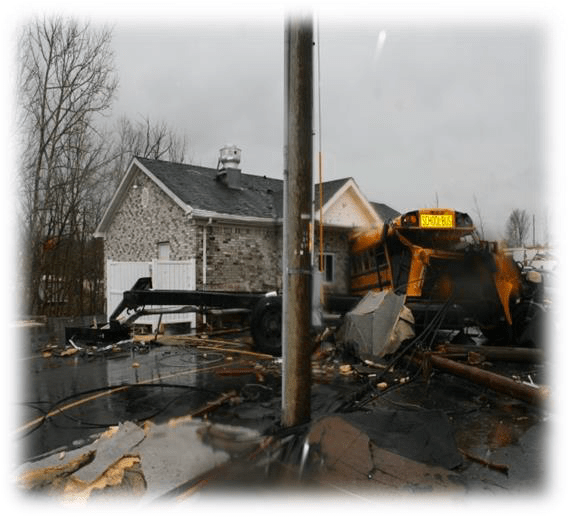
This school bus in the picture was thrown over 300 ft. into a restaurant. A very large missile, indeed. The black bar running horizontally, to the left, is the frame of the bus. The chassis was torn from the frame upon impact.
(Photo: Stephen Satterly, II)
Tornadoes create a wide range of debris, with even the smallest having the potential to penetrate some building material, degrade building integrity, or lead to injuries. Larger debris can cause a crushing-type of damage. Thus, when considering materials for school facilities, choose those materials which will sustain projectile damage while maintaining structural integrity. Long hallways should not have roof struts that run lengthways. Struts greater than 25ft in length are prone to failure, and perpendicular cross struts provide much better support. Hallways also can become wind tunnels during tornadoes. Exterior walls can baffle wind and provide missile protection reducing potential problems. Two walls, between a hallway used as a refuge of last resort, and the exterior is recommended. This provides more protection in the event of a collapsed exterior wall.
The National Weather Service’s (NWS) Enhanced Fujita (EF) Scale implemented in 2007, categorizes tornadoes as a function of both wind speed (minimal three-second-gust speed) and resulting damage. The EF scale has 6 levels, starting at zero with a maximum of five. A building that can survive an EF5 tornado would exceed strength capacity requirements of any local building codes. The goal therefore is to harden areas of the building to protect the occupants.
Preparedness
Harden means specialized design and construction applied to a room, or building, which allows the building to resist wind pressures and wind-borne debris impacts, during a severe wind event (FEMA P-361, 2008). Hardening can include the use of reinforced concrete, masonry to resist projectile damage, and methods that more firmly attach the roof to supporting walls to make it more wind-resistant.
Heavy building materials, like reinforced masonry or concrete, securely tied to other building components, often survive severe wind events. These materials can resist the uplift and lateral shifting forces. If not adequately reinforced, or connected to other building components, these materials are more prone to failure. Lightweight materials such as siding and roofing, also are more prone to failure and may produce building damage.
Regions identified as high risk for tornadoes, should consider a safe-room built to FEMA P-361 standards. If not feasible, a hardened area needs to be provided (FEMA P-361, 2008).
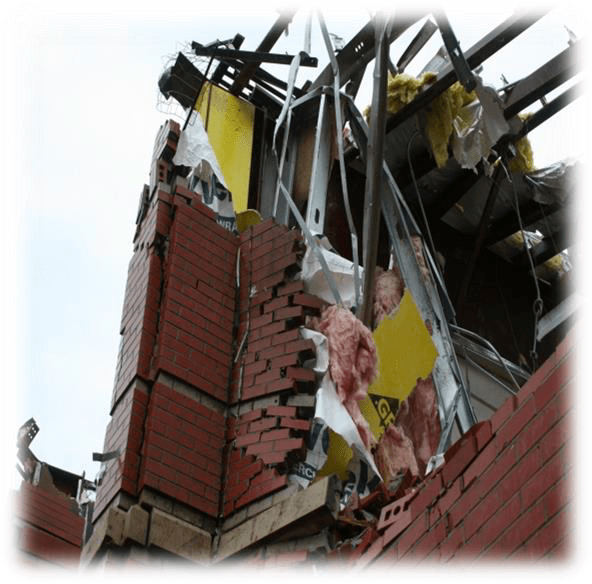
Designing for Response and Recovery in Schools
While school facility design is vital in the mitigation and preparedness phases, it also has a role in response and recovery, the manner depending on whether the building is a safe room, or shelter.
In hurricane-prone areas, where tornadoes are often spawned, the minimum wind load, based on a three-second gust, is in the range of 140 to 150 mph. FEMA recommendations for safe- rooms, in these same areas, is to protect against winds in the range of 200 to 225 mph. These specified small safe-rooms, can provide “near-absolute protection” for occupants in the event of a tornado or hurricane (FEMA P-361, 2008).
Design criteria for safe-rooms resistant to the impact of debris may be the most significant influence to the cost of the room. Impact resistant elements such as doors, windows, vents, or heating/cooling systems add to the costs of the safe-room, as they are less common.
“Costs for these systems range from $50 (for basic code compliance) to $400 per square foot (FEMA safe-room criteria levels)” (FEMA P-361, 2008). Every window, or opening, in a safe room has a significant impact on costs.
A school with a community shelter will need to be designed so the intended occupants have easy access. Safe-room entrances and the pathways leading to them should be well-marked and meet dimensional requirements and maximum traffic expectations during an emergency. Consideration should be given to the safety of access pathways when selecting a safe room location. Also, consideration should be given to avoiding areas of potential ceiling collapse. Safe-rooms should include storage space for water, food, and emergency kits for the maximum load per FEMA P-361 standards (FEMA P-361, 2008).
If a safe-room is not the goal of the design, then the design should include a shelter area, or the occupants of the building will be left using the best available areas as a refuge of last resort. International Code Council/National Storm Shelter Association (ICC/NSSA) Standard for the Design and Construction of Storm Shelters (ICC-500, 2008) provides guidance for the design of shelter areas, while FEMA P-431 provides guidance for the selection of best available areas of last resort (FEMA P-431, 2009).
Similar considerations are required for shelter areas, including signage. Shelters do not offer the same protection as safe-rooms, though location is critical. Thus, balance between location, and the ability to exit, must be considered. Shelters also need to factor in storage space for supplies.
Summary
Prior to designing or renovating any school facility for potential natural hazards, a threat assessment should be conducted, using Hazard Checklists, Wind Zones resources, and historic data on tornadoes as outlined by FEMA and the National Oceanic and Atmospheric Administration as guidelines (FEMA, 2008; NOAA, 2013) .
Locations at high risk of tornadic activity should include plans for a community safe room, using the criteria from FEMA P-361. In lieu of safe-room or shelter areas, it is still possible to design with tornado safety in mind.
Building designs should take the two major types of tornado damage, wind and missiles, into consideration. Each type has specific design specifications to help mitigate damage. It is in the mitigation phase of the all-hazards planning approach that the building designer can earn their keep. Every dollar spent in mitigation may save as much as $4 in recovery (MMC, 2005). FEMA P-361, the International Code Council/National Storm Shelter Association Standard for the Design and Construction of Storm Shelters (ICC/NSSA), and FEMA P-431, are some of the numerous design guides at the designer’s disposal when planning for a safe room or a shelter. If neither a safe room nor a shelter will be used, then alternate areas of the building will be used as a refuge of last resort, and there are design specifications for those areas, as well.
Building design is also important in how the occupants of a building can respond and recover from a tornado. Consideration must be given to access, simple infrastructure such as signage, utility cutoffs, and storage, which must be factored into a building’s design, and integrated with the level of protection being designed into the building.
Tornadoes are unpredictable and can create massive damage in a short amount of time. Since school facilities are the social and economic core of many communities, the loss of a school to a tornado will have a tremendous impact. A community’s most precious resource, its children, spend much of their day in the school facility. Therefore, the safety of those facilities is essential and rests in the school facilities’ design.
Stephen Satterly, II, is a researcher, author, and a senior analyst with Safe Havens International. He can be reached at stephencsatterly2@gmail.com.
 Stephen C. Satterly, II - Author
Leave a comment