Treating Educator Sexual Misconduct as a Risk for Schools
There are some who will look at the title and think it strange. “Isn’t educator sexual misconduct a risk to schools?” Answering ‘yes’ to that question doesn’t mean schools are treating it as a risk. There are prescribed ways for schools to manage risk and incorporate them into a response plan. Only when schools treat educator sexual misconduct like other risks can schools state they are “doing something” about this pervasive problem.
There might be some who think that a school facing allegations that one of its employees has engaged in educator sexual misconduct is not an emergency, but this would be in error. As written in the Guide, “By having plans in place to keep students and staff safe, schools play a key role in taking preventative and protective measures to stop an emergency from occurring or reduce the impact of an incident,” (Page 1). Schools often state, “The safety of our students is our top priority,” or similar wording. Yet, they don’t properly address educator sexual misconduct, which does lifelong damage to the student and may create liability, both criminal and civil, that can result in prison sentences and/or monetary payments to the victims. One in ten students experiences sexual abuse by a school official before graduating (Shakeshaft, 2004).
In 2013, the U.S. Department of Education released its “Guide for Developing High-Quality School Emergency Operations Plans” (hereafter referred to as “The Guide”). The Guide identifies five parts of a comprehensive approach: Prevention, protection, mitigation, response, and recovery.
Prevention is the steps schools take to prevent an incident from occurring. Protection is an ongoing process that safeguards students, teachers, staff, visitors, networks, and property from threats and hazards. Mitigation means reducing the likelihood that threats and hazards will happen. Response is the capability to stabilize an emergency once it has already happened; establish a safe, secure environment; save lives and property; and facilitate the transition to recovery. Recovery is the capability to assist schools affected by an event or emergency in restoring the learning environment (Guide, p. 2).
Step One in the process is to form a collaborative planning team. When preparing to address educator sexual misconduct, schools need to remember that laws and standards of care apply, and to ensure these are factored into their planning.
The core planning team should include representatives from a wide range of school personnel, including, but not limited to, administrators, educators, school psychologists, nurses, facilities managers, transportation managers, food personnel, and family services representatives. It should also include student and parent representatives, and individuals and organizations that serve and represent the interests of students, staff, and parents with disabilities, and others with access and functional needs, as well as racial minorities and religious organizations, so that specific concerns are included in the early stages of planning (Guide, p. 6).
Step Two is to understand the situation. The planning team needs to identify threats and hazards to students and the school, then assess the risk posed by those threats and hazards. What are the state laws pertaining to educator sexual misconduct? What are the board policies and administrative guidelines on the topic? What type of training is provided to administrators, staff, and students? What are the reporting policies and procedures? What is the standard of care?
A site assessment should be conducted to identify any physical spaces that could be conducive to illicit behavior. Do classroom doors have uncovered windows to provide natural surveillance? Are there areas of the school that are not covered by security cameras, and are these spaces regularly secured when unoccupied?
A culture and climate assessment can check whether there is actual educator sexual misconduct currently going on, which can be problematic, as students do not often report abuse. However, if 1 in 10 students are reporting educator sexual misconduct, and the issue is under-reported, then simple math can be used to estimate the scope of the problem. Let’s say a school corporation has 3,000 students. 10% of 3,000 is 300 students. Is 300 students a big enough population to address with this process, especially given the issue of the dark number of educator sexual misconduct? The district can use student, staff, and parent surveys to collect data to consider. One benefit of this is that educators who may be engaging in sexual misconduct may decide to leave and go elsewhere. Knowing that the district has such a robust process can also be an impediment to hiring predators.
A capacity assessment helps the school identify the resources available to address educator sexual misconduct and those in the community. This assessment is important because it identifies resource gaps and enables steps to address them.
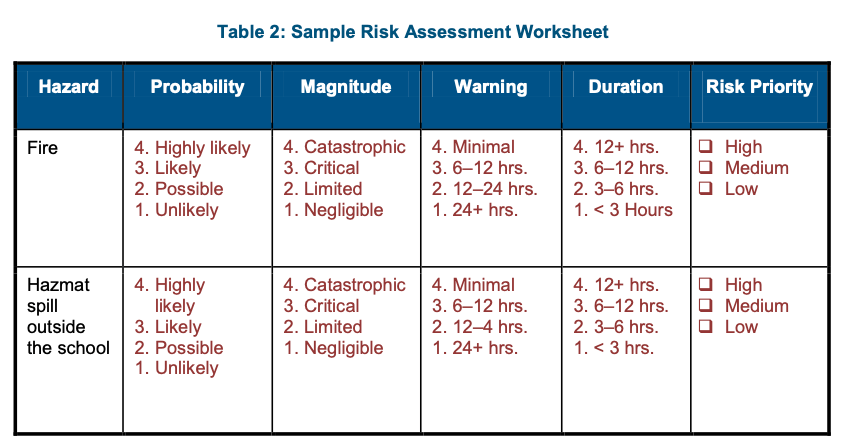
These assessments will provide data for the planning team. This data needs to be considered in terms of the consequences and scope of impact on the district and its schools. The team will need to consider the probability of the threat occurring, the magnitude of the event, the time the district will have to respond to an incident of this type, the duration of the incident, and the risk priority. Table 2 below shows an example of this type of assessment.
(Guide, p. 13)
Here, there is a slight deviation from the Guide. The Guide, at this point, describes a process for developing high-, medium-, or low-priority hazards. For K-12 schools, the standard of care is to prioritize educator sexual misconduct, so schools should create plans to address it.
Step Three is to create goals and objectives. According to the Guide, “Goals are broad, general statements that indicate the desired outcome in response to the threat or hazard identified by planners in the previous step,” while “Objectives are specific, measurable actions that are necessary to achieve the goals” (Guide, pp 12-13). The Guide recommends creating at least three goals: one for before, one for during, and one for after an incident.
Step Four is plan development. The planning team should create courses of action for each identified objective. As noted in the Guide, “Courses of action include criteria for determining how and when each response will be implemented under a variety of circumstances” (Guide, p. 14). The Guide provides examples of possible courses of action before, during, and after an incident of educator sexual misconduct, including:
Creating a scenario on the issue,
Determine the amount of time available to respond
Identify decision points
Develop courses of action. * What is the action? * Who is responsible for the action? * When does the action take place? * How long does the action take, and how much time is actually available? * What has to happen before? * What happens after? * What resources are needed to perform the action? * How will this action affect specific populations, such as individuals with disabilities and others with access and functional needs who may require medication, wayfinding, evacuation assistance, or personal assistance services, or who may experience severe anxiety during traumatic events (Guide, pp. 14-15)?
Step Five of the process is for the planning team to draft the emergency operations plan. It should be formatted like the parts of the school’s EOP, so that the planning team can write the plan. The plan should then be reviewed and graded as either adequate, feasible, acceptable, or complete. The plan should also be checked for compliance against applicable federal and state laws, as well as board policies and administrative guidelines.
Step Six is plan implementation and maintenance. Here, the school trains stakeholders on their roles, exercises the plan, then reviews, revises, and maintains the plan.
Educator sexual misconduct is a major incident for a school to face. There are lifelong consequences for the victim and their families. As such, the school should prepare for them as it would for other emergencies. The Guide for Developing High-Quality School Emergency Operations Plans provides excellent guidance for schools to make sure their plan to address this issue is sound.
The term standard of care has been mentioned several times in this post. In subsequent posts, I will outline the standard of care for educator sexual misconduct, which requires schools to develop plans to address this issue.
Follow the proper guidance, and make sure you have a sound, workable plan. Your students deserve nothing less.
Stephen Satterly, II, is a researcher, author, and expert witness in school safety cases. He can be reached at schoolsafetyshield@gmail.com

 Stephen C. Satterly, II - Author
Leave a comment