Such is the nature of my work in school safety that I receive news alerts on various aspects of it. This includes instances of educator sexual misconduct. I realized I was seeing more frequent stories about awful decisions people make that betray the trust between adults and children. In talking with a friend of mine, he observed that these stories seemed to be becoming more frequent and wondered if it was true. I told him it was a good question.

Another aspect of my line of work is that I focus on data. Schools need to prepare to address identified risks and hazards. The first step is always to conduct a risk assessment to identify what specific issues the school needs to address. So what does the data say about the risk to students from educator sexual misconduct? Is it getting worse, or better?
Until around 2003, there wasn’t much research on the subject. In fact, there were no national studies to determine its prevalence. Much of the focus in schools was on child abuse, not child sex abuse, which is a subset of child abuse. Educators were being trained on noticing the signs of neglect or physical abuse, and who to report their concerns to.
A recent Fox News story notes that 349 educators were arrested for child sex crimes in 2022. 75% of those arrested were for crimes against students. As Jessica Chasmer reported, “The 349 educators included five principals, three assistant principals, 290 teachers, 26 substitute teachers, and 25 teachers’ aides spanning nearly every state in the country. As bad as this story is, it only provides a recent snapshot of the problem’s scope. So how do we get solid data? Enter Dr. Charol Shakeshaft.
Dr. Charol Shakeshaft
Dr. Shakeshaft, along with Dr. Audrey Cohen, published a study in 1994 entitled, In Loco Parentis: Sexual Abuse of Students in Schools. They defined sexual abuse, examined the prevalence, and offered some recommendations. The study was conducted through interviews of New York State school superintendents.
The superintendents were more likely to report physical abuse than non-physical abuse. 89% of reported cases were physical sexual abuse. Physical abuse accounted for 92% of reported incidents by males and 88% of reported incidents by females. Looking at all cases, 38% were at the elementary level, 20% at the secondary level, and 36% at the high school level. They found 6% of the cases occurred across levels. 96% of the perpetrators were male, 4% were female. (Shakeshaft, 1994)
In 2003, Dr. Shakeshaft followed In Loco Parentis with a study called Educator Sexual Abuse. In that study, she wrote, “This analysis indicates that 9.6 percent of all students in grades 8 to 11 report contact and/or noncontact educator sexual misconduct that was unwanted. 8.7 percent report only noncontact sexual misconduct, and 6.7 percent experienced only contact misconduct.” Of the students contacted for the study, 21 percent were victims of educators, while the remaining 79 percent were victims of other students (Shakeshaft, 2003) When extrapolated out to the total student population in the U.S., Dr. Shakeshaft reported that 4.5 million children ar e subjected to educator sexual misconduct between kindergarten and twelfth grade.
The Shakeshaft Study
In 2004, the U.S. Department of Education posted its report, Educator Sexual Abuse: A synthesis of existing literature, written by Dr. Shakeshaft. She noted that, at the time of the study, there were only 14 nationwide U.S. studies on the topic of educator sexual misconduct. There were five Canadian or U.K. studies. Only one of the U.S. studies was federally funded.
One of the nationwide studies was by the American Association of University Women (AAUW). They conducted a survey called Hostile Hallways in 1993 and again in 2000. It’s the only study that provided reliable nationwide data, but it was primarily focused on peer-to-peer sexual misconduct. Other studies were narrowly focused or had flawed methodologies.
The ‘Dark Number’ of Educator Sexual Misconduct
The biggest issue is that police and social services agencies receive reports in only 5 to 6 percent of the incidents. This is a large “dark number” that exemplifies the difficulties in measuring the prevalence of educator sexual misconduct. The term ‘dark number’ was coined by Belgian criminologist Adolphe Quetelet to describe cases that have not been reported for various reasons. This is good to keep in mind as we consider the findings.
The Prevalence of Educator Sexual Misconduct
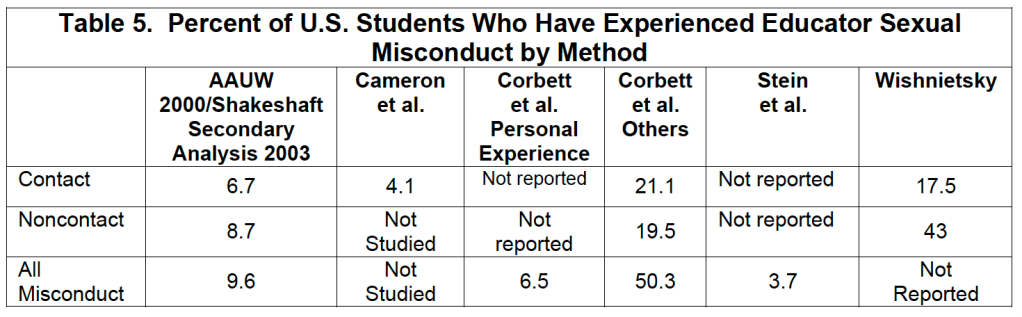
The table above shows the prevalence found in the various studies. Dr. Shakeshaft wrote, “Because of its carefully drawn sample and survey methodology, the AAUW report that nearly 9.6 percent of students are targets of educator sexual misconduct sometime during their school career presents the most accurate data available at this time,” (Shakeshaft, 2004).
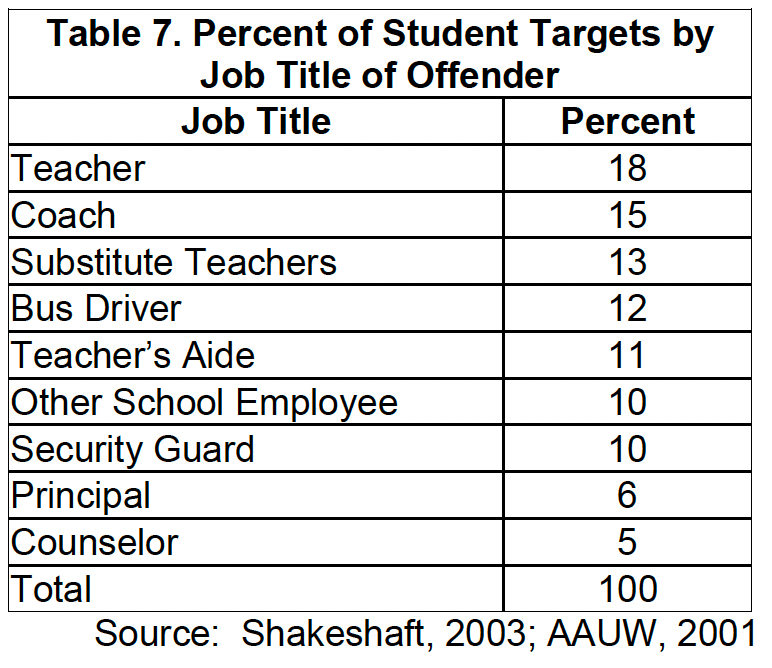
Table 7 shows the breakdown of the perpetrators by job titles. Dr. Shakeshaft wrote that teachers who spent individual time with students, such as music teachers and coaches, were more likely to engage in educator sexual misconduct.
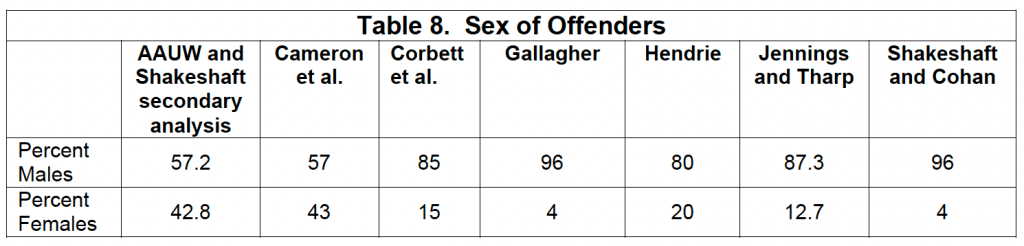
Table 8 shows the breakdown by sex of the offender. With the exception of the Gallagher Study (Gallagher, 2002), Dr. Shakeshaft notes that the findings are in contrast to the research on child sex abuse in general. The findings show that 90 to 98 percent of females and 18 to 86 percent of males are sexually abused by a male (Finkelhor, 1985).
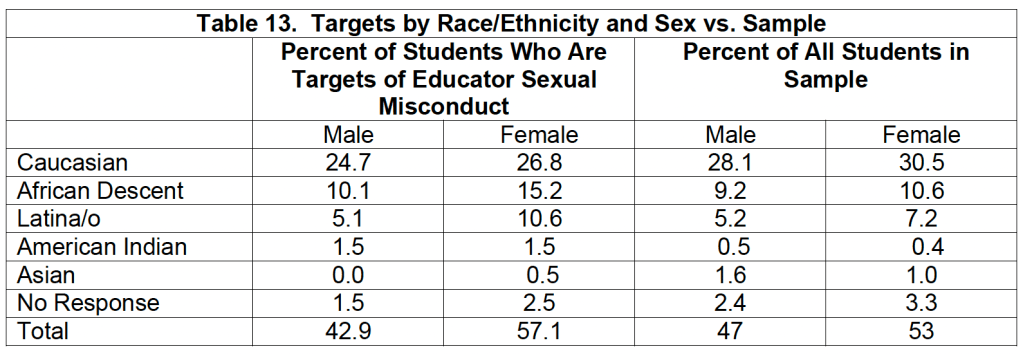
Table 13 shows the percentage of students by race and sex who report having been targeted by an employee of a school district. Females, particularly females of color, are overrepresented as targets of educator sexual misconduct with regard to their proportion of the population. Dr. Shakeshaft writes, “Females are 53 percent of the sample and 57 percent of the targets of educator sexual abuse. Females of color are 18.2 percent of the sample and 27.3 percent of those targeted” (Shakeshaft, 2004).
Students with Special Needs
Dr. Shakeshaft also looked at students with special needs. She found even less data than for general education students, but she was able to calculate that, “8.8 percent of students with disabilities vs. 2.8 percent of students without disabilities were sexually abused. Students with behavior disorders are more than five times as likely as non-disabled students to be sexually abused, with mentally retarded students more than three times as likely” (Shakeshaft, 2004).
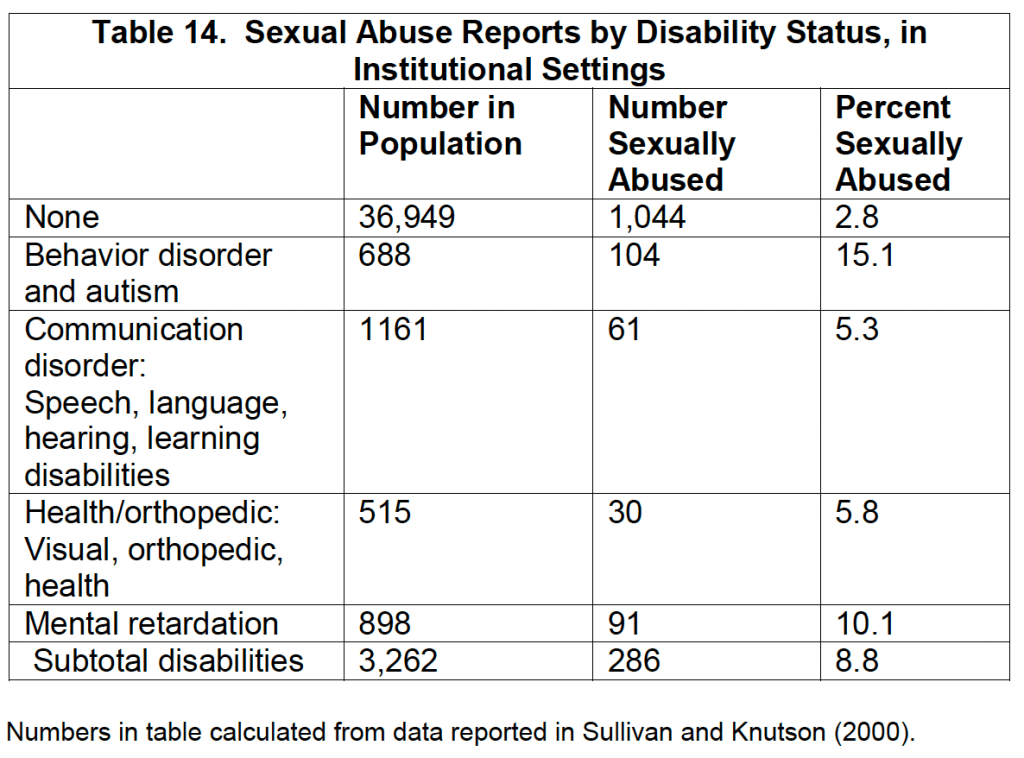
Table 14 shows data collected in the U.K., indicating that students with special needs accounted for 17 percent of reported cases (Gallagher, 2002). A University of Alberta Study found, “7 percent of the sexual abuse of disabled children came from bus drivers” (ADP, 1992). This is important, as many students with special needs are transported to off-site services.
The Costs of Educator Sexual Misconduct
Dr. Shakeshaft noted on her analysis of the AAUW study, “Reanalysis of the AAUW data indicates that targets of educator sexual misconduct report that they suffer emotional, educational, and developmental or health effects. At least a third of students report behaviors that would negatively affect academic achievement:
- Avoid the teacher or other educator (43 percent).
- Do not want to go to school (36 percent).
- Do not talk much in class (34 percent).
- Have trouble paying attention (31 percent).
- Stayed home from school or cut a class (29 percent).
- Found it hard to study (29 percent).
Dr. Shakeshaft also found that students suffered negative health effects, such as appetite loss and sleep disorders, which were reported by 28 percent of students. Many students report negative feelings of self-worth because of the abuse.
- Felt embarrassed (51 percent).
- Felt self-conscious (39 percent).
- Less sure of self or less confident (37 percent).
- Felt afraid or scared (36 percent).
- Felt confused about identity (29 percent).
- Doubted whether could ever have a happy romantic relationship (29 percent).
Dr. Shakeshaft goes on to write,
Sexually abused children are more likely than children
who are not sexually abused to become substance users
as adults and to have difficulty forming intimate
relationships . David Finkelhor, the premier researcher
of child sexual abuse, notes that the same sense of
betrayal and shame that attaches to incest is found in
sexual abuse by teachers, where the pseudo-parental
relationship that the teacher plays has been sexualized
(Finkelhor, 2001).
Answering the Question
So in answer to the question, “How bad is it?” The answer is, “Not good.”
There are numerous reasons why examining this topic is so difficult. Google suspended an email address associated with this blog site because of the content of this blog post. Educator sexual misconduct is a serious issue, and, numbers-wise, it is an even worse issue than the Catholic Church faces.
School safety leaders have no choice but to do the hard thing and address this problem. There are discrete things that can be done, from employment screenings to supervision techniques to board policies. I will address these topics, and more, as we face this darkness together.
Children come to school trusting their teachers to foster healthy, respectful relationships as we equip them with the skills they need to become functional members of society. They don’t need selfish, deluded people to betray them for their own selfish ends. As leaders in school safety, it’s up to us to provide a safe space for these trusting relationships to flourish.
Bibliography
Abuse and Disability Project (1992). University of Alberta, Edmonton, Canada.
American Association of University Women. (2001; 1993).Hostile hallways: The AAUW survey on sexual harassment in America’s schools. Washington, D.C.: American Association of University Women.
Chasner, Jessica. “Nearly 350 K-12 educators arrested on child sex crimes in 2022.” Fox News. January 10, 2023. Retrieved on April 1, 2026, from: https://www.foxnews.com/us/nearly-350-k-12-educators-arrested-child-sex-crimes-2022
Finkelhor, D. and A. Browne (1985). The traumatic impact of child sexual abuse: A conceptual model. 55. American Journal of Orthopsychiatry, 530.
Finkelhor, D. and Hashima, P. (2001). The victimization of children and youth: A comprehensive overview. In: Law and Social Science Perspectives on Youth and Justice. (S.O. White, Ed.). Plenum Publishing. New York, N.Y. pp. 49-78.
Gallagher, B. (2002, August). Cases of international or Internet child sexual abuse. Center for Applied Childhood Studies, School of Human and Health Sciences, University of Huddersfield, W. Yorkshire, UK.
Shakeshaft, C. (2003, Spring). Educator Sexual Abuse. Hofstra Horizons, pp. 10-13.
Shakeshaft, C., and Cohan, A. (1994, January). In loco parentis: Sexual abuse of students in schools (What administrators should know), 1-40. Administration and Policy Studies, Hofstra University.
Shakeshaft, C. (2004).Educator Sexual Misconduct: A Synthesis of Existing Literature. U. S. Departmentof Education, Office of the Under Secretary. DOC # 2004-09.
 Stephen C. Satterly, II - Author
Leave a comment