By Dr. Sonayia Shepherd, Stephen Satterly, Chris Dorn, and Phuong Nguyen, The Safety Net, October 2014
The FBI released a major study on September 24, 2014, entitled A Study of Active Shooter Incidents in the United States Between 2000 and 2013. The primary purpose of the study is to provide law enforcement with data to better prepare for and respond to Active Shooter Incidents (ASIs), thereby saving more lives and reducing the risk of copycat incidents.
The FBI identified 160 ASIs between 2000 and 2013, resulting in 486 people killed, excluding the shooters, and 557 others being wounded. One of the major findings was that ASIs are becoming more frequent. The first seven years of the study average 6.4 incidents annually, while the last seven years average 16.4 incidents annually.
It was also noted that all but six shooters were male. Of the six female shooters, two ASIs were in Institutes of Higher Education (IHEs), and four were in businesses. The six female shooters accounted for 15 dead and 7 wounded. A third finding worth noting is that 90 ASIs (56.3%) ended at the shooter’s initiative. That means they either committed suicide or fled the scene. Twenty-one ASIs (13.1%) were ended by unarmed citizens restraining the shooter.
The findings also reflect the damage caused by ASIs, which can occur within minutes. Even when law enforcement personnel were present or able to respond within minutes, civilians typically had to make life and death decisions without much time to react. This means that school staff must be engaged in training and discussions on the decisions that need to be made within the first moments of an ASI or any other crisis event. There were 64 incidents for which the duration could be determined. Forty-four (69.0%) of the 64 incidents ended in 5 minutes or less, while 23 ended in two minutes or less.
The data in this study support the notion that campus safety professionals should provide all employees with adequate training to help them make necessary life-or-death decisions in responding to these events until law enforcement officers arrive (which, in the best-case scenario, can take two to three minutes). Even with an ideal law enforcement response time, the decisions that will most impact the outcome of the event are likely to occur within the first few seconds.
Our research shows that the best defense against an active shooter can be to identify the violent offender before they begin the actual attack phase. This approach has helped stop many attempted ASIs outright and has reduced the loss of life in many other instances. An effective threat assessment using multi-disciplinary threat assessment teams is another evidence-based prevention measure. Finally, educating people on the warning signs of violence most often present before a violent act should be incorporated into every prevention program. The research shows that the adage “An ounce of prevention equals a pound of cure” holds true when preparing for violence as well.
It is equally important to teach people situational awareness skills that emphasize environmental awareness. These skills can often help people avoid dangerous situations and enable them to act on the input they gather quickly enough to take protective action in time to make a difference in the outcome.
In the event of an ASI, several measures can be taken until the police arrive. Immediate steps should be taken to protect oneself based on tactical considerations at the time of the incident. Once critical life-preserving steps have been taken, it may be necessary to protect others, again based upon the tactical considerations at the time. There is considerable debate over which training approach is most practical for this purpose, but there are many success stories worth researching and considering.
Of particular interest is the fact that this FBI study has changed the definition of an active shooter. In 2013, the Department of Homeland Security and the FBI, along with other federal agencies, defined an active shooter as “an individual actively engaged in killing or attempting to kill people in a confined and populated area; in most cases, active shooters use firearms, and there is no pattern or method to their selection of victims.” However, in the current study, the FBI excluded the word ‘confined’, explaining that it could omit incidents that occurred outside a building.
In addition, the FBI also dropped the randomness of victim selection from this study’s definition. This is why there is a noticeable increase in the number of active shooter events, injuries, and deaths. In 2013, victim selection was integral to defining an active shooter. By removing victim selection, more incidents are classified as Active Shooter Incidents. This significantly affects the results, especially given the finding that ASI figures are increasing by more than 250% compared to previous studies.
The FBI provided a graphic that showed the number of ASIs per year from 2000-2013, along with a trend line that showed the incidents were on the increase:
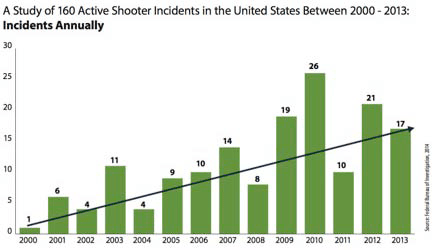
The study indicates that while more ASIs have occurred, no additional acts of violence have taken place. We feel this is a very important point. How the data is interpreted will affect the types of intervention and response applied. It is important to understand that a change in how the federal government defines ASIs, rather than in interpreting the ASI data, will show a sudden increase in ASIs. What is unclear is whether the change in definition reflects a change across the federal system or is specific to this study.
Note that in K-12 schools, the number of ASIs per year shows a neutral trend. In fact, even though the FBI study finds that ASIs are increasing overall, it does not show an increase in K-12 environments. For K-12 school safety professionals, this highlights accomplishments in preparedness efforts over the past 16 years.
A recent study entitled Relative Risks of Death in U.S. K-12 Schools listed the ASIs in K-12 schools from 1998-2012. Adding the K-12 incidents in 2013, using the 2013 DHS definition, will make the chart look like this, with the trend line added:
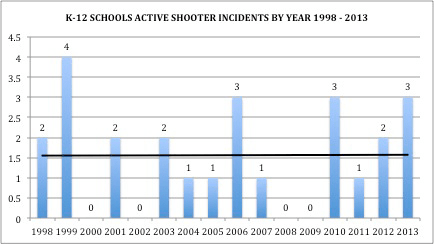
Schools have improved their threat assessment processes, hardened their facilities, and improved their responses to acts of violence, and it shows. While ASIs appear to be on the rise in other settings, they remain stable in the school environment over the same period, using the same metrics. Perhaps the practices used in schools could be adapted for use in businesses, houses of worship, and hospitals to help reduce ASI incidents in those facilities.
These practices are best when they are researched, proven to work, and replicable in any facility. The FBI study is a great start for campus safety professionals to look deeper into the active shooter phenomenon and its impact on our profession. A critical eye is necessary to consider the report and its implications, as well as the applications to our profession. This report underscores the need for further research and for considering the long-term implications of any plan we implement.
A good start for training is the free FEMA courses listed on the previous page with the study charts. Of course, it is always helpful to start with a solid foundation in the other topics covered in the free training, including emergency management, exercise design, the National Incident Management System (NIMS), and other courses that lay the groundwork for a solid emergency preparedness and response plan.
Lastly, we want to point out that schools remain among the safest places for children. As pointed out above, the actual rate of violent incidents has not changed; only their categorization has. That means that school-related homicides still account for less than 1% of all juvenile homicides. As found in Relative Risks of Death in K-12 Schools, school transportation-related deaths are still the leading cause of fatalities in K-12 school environments.
This article was co-authored by SHI analysts Stephen Satterly, Dr. Sonayia Shepherd, Chris Dorn, and Phuong Nguyen. This article draws heavily from the research conducted by Stephen Satterly for his report “Relative Risks of Death in U.S. K-12 Schools” in 2014.
Sources & Further Reading:
“Relative Risks of Death in U.S. K-12 Schools” Report & Infographics: http://safehavensinternational.org/K12-School-Deaths/
FEMA IS-360: Preparing for Mass Casualty Incidents: https://training.fema.gov/EMIWeb/IS/courseOverview.aspx?code=IS-360
FEMA IS-907: Active Shooter Web Course: http://training.fema.gov/EMIWeb/IS/courseOverview.aspx?code=IS-907
Stephen Satterly, II, is a senior analyst with Safe Havens International. He is also a researcher and author. He can be reached at stephencsatterly2@gmail.com.
 Stephen C. Satterly, II - Author
Leave a comment