By Michael S. Dorn, Stephen Satterly, II, Phuong Dorn, and Chris Dorn, Safe Havens International
I. Overview of Violent School Deaths in the United States
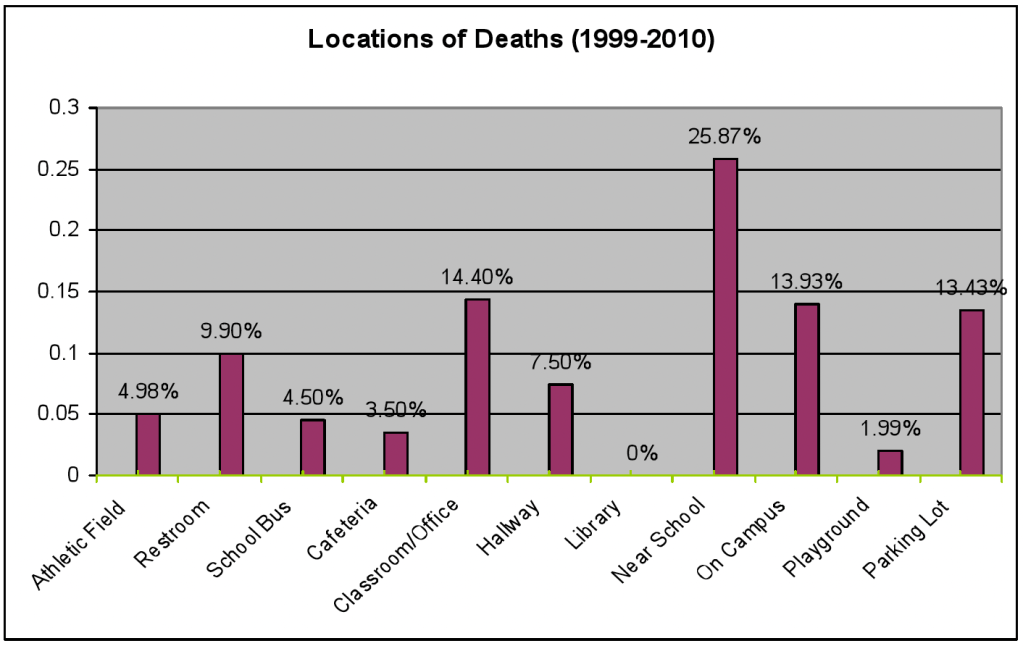
School-associated violent deaths, as defined by the National School Safety Center (2010), include deaths resulting from homicide and suicide, caused by fighting, use of weapons on school property, and heart attacks resulting from incidents of violence. This includes deaths on the campus itself as well as on school buses or on the way to or from a school. The data shows that these incidents are statistically rare in the United States (U.S.). According to the Center’s report (2010), there were a total of 201 school-associated deaths between school years of 1999-2000 and 2009-2010, or an average of 18.27 deaths per year during that period, in the U.S.
At the same time, according to the National Center for Education Statistics of the U.S. Department of Education (2012), there were an average of 130,639 schools, including public, private, and parochial elementary K-12 schools, per school year during 1999-2000 and 2009-2010. This means that, on average, any given school in the U.S. will experience a violent death once every 7,150.47 years.
It should be noted that 38.65 percent of the deaths were near schools. We should also point out that, though the report is considered by many in the field to be one of the more reliable listings of school-related violent deaths, the incidents reported are typically based on information obtained from media accounts of incidents. The following charts provide additional insight into the locations of deaths reported in the report.
Watershed Events in School Violence, 1764 through 2012
The following are key events in school violence in the United States that had a dramatic effect on the public consciousness and the ways in which we perceive and respond to school violence.
• July 26, 1764 – Enoch Brown Massacre: Greencastle, PA; 11 killed.
• April 9, 1891 – St. Mary’s School Shooting: Newburgh, NY; Several wounded. This was the first known mass shooting in the U.S. in which an American citizen shot students.
• May 18, 1927 – Bath School Disaster: Bath, MI; 43 killed. This is the deadliest mass murder using firearms and explosives at a K-12 school in the history of the United States.
• December 1, 1958 – The Our Lady of the Angels School arson fire: Chicago, IL; 95 killed. This was the largest loss of life due to an act of violence in United States history.
• August 1, 1966 – University of Texas Massacre: Austin, TX; 16 killed, 31 wounded.
• May 16, 1986 – Cokeville ES Hostage Crisis: Cokeville, WY; 2 killed, 76 wounded.
• October 1, 1997 – Pearl HS Shooting: Pearl, MS; 3 killed, 7 wounded.
• December 1, 1997 – Heath HS Shooting: West Paducah, KY; 3 killed, 5 wounded.
• March 24, 1998 – Jonesboro MS Shooting: Jonesboro, AR; 5 killed, 10 wounded.
• May 21, 1998 – Thurston HS Shooting: Springfield, OR; 3 killed, 25 wounded.
• April 20, 1999 – Columbine Massacre: Littleton, CO; 15 killed, 24 wounded. This shooting became one of the most well-known school shootings and became a symbolic unifying point for the nation to start taking a concerted effort for school safety. This incident and others in the same time period prompted the creation of many of the school safety programs in existence today.
• February 29, 2000 – Buell Elementary School Shooting: Flint, MI; 6-year-old, the youngest-ever school shooter, shot and killed classmate Kayla Rolland.
• March 21, 2005 – Red Lake Shooting: Red Lake, MN; 9 killed.
• September 27, 2006 – Platte Canyon HS Hostage Situation: Bailey, CO; Six girls were taken hostage and sexually assaulted. 2 killed
• October 2, 2006 – Nickel Mines Massacre: Nickel Mines, PA; 6 killed, 5 wounded. This particularly shocking attack took place in a one-room Amish schoolhouse.
• April 16, 2007 – Virginia Tech Massacre: Blacksburg, VA; 33 killed, 17 wounded. This attack was similar to Columbine in the level of infamy due to the fact that the attack was the largest loss of life from an attack with a firearm in a U.S. school.
• February 27, 2012 – Chardon HS Shooting: Chardon, OH; 3 killed, 3 wounded.
• December 14, 2012 – Sandy Hook Massacre: Newtown, CT; 28 killed
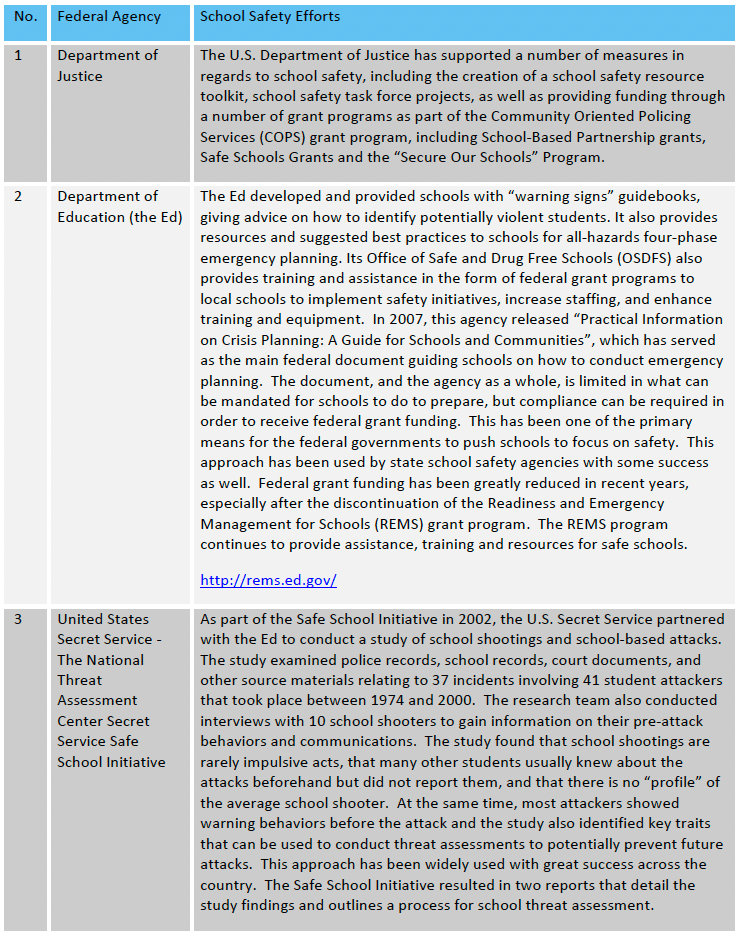
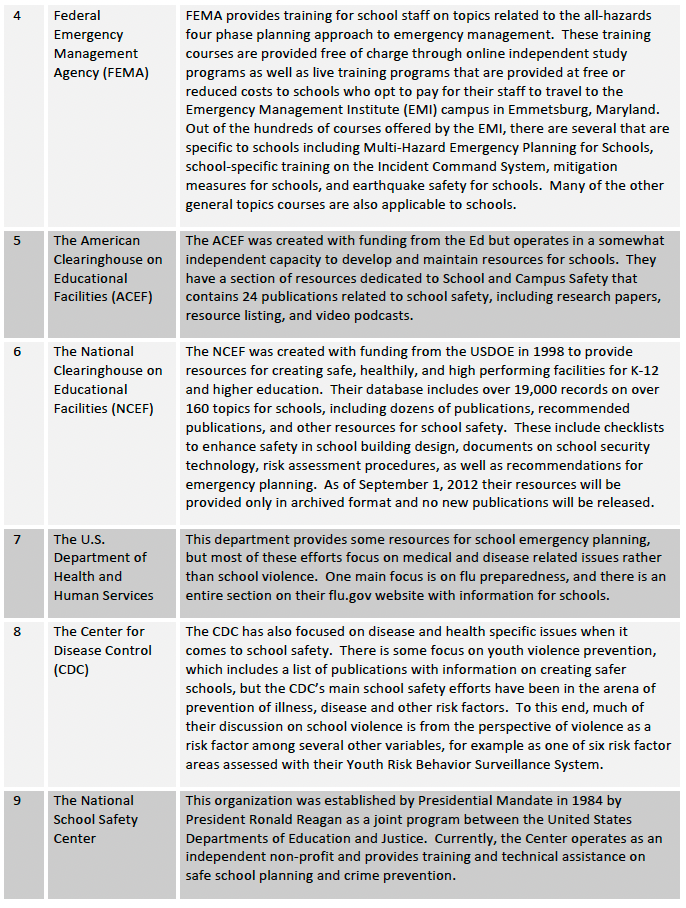
II. School Safety Responses and Approaches by Federal Agencies
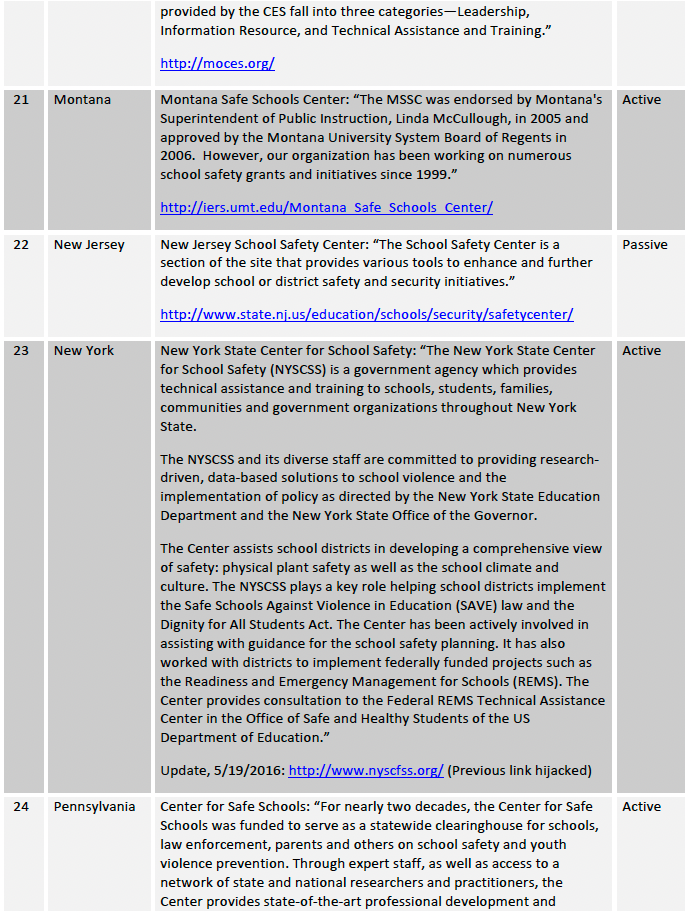
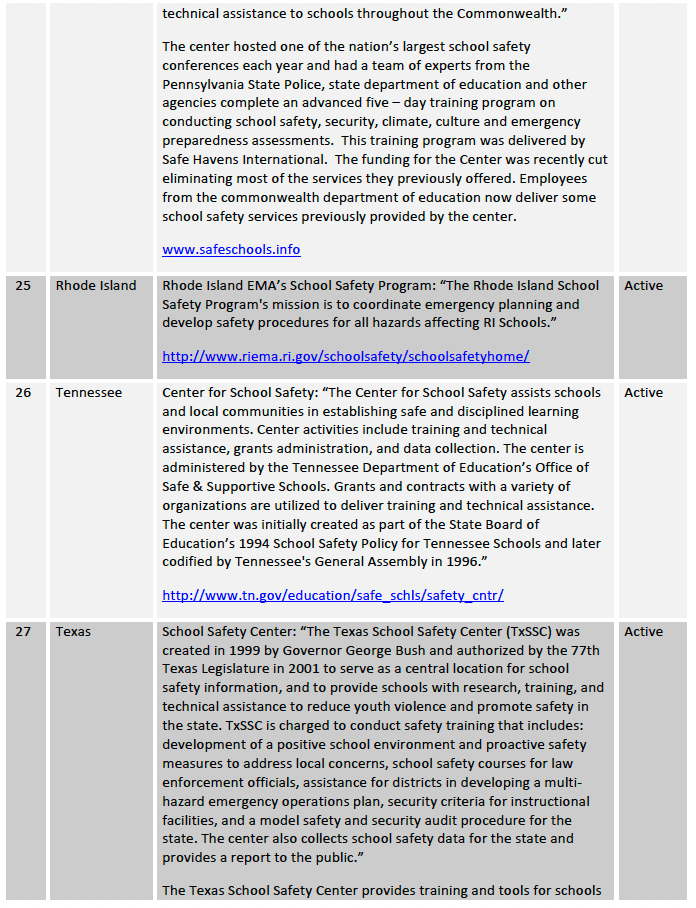
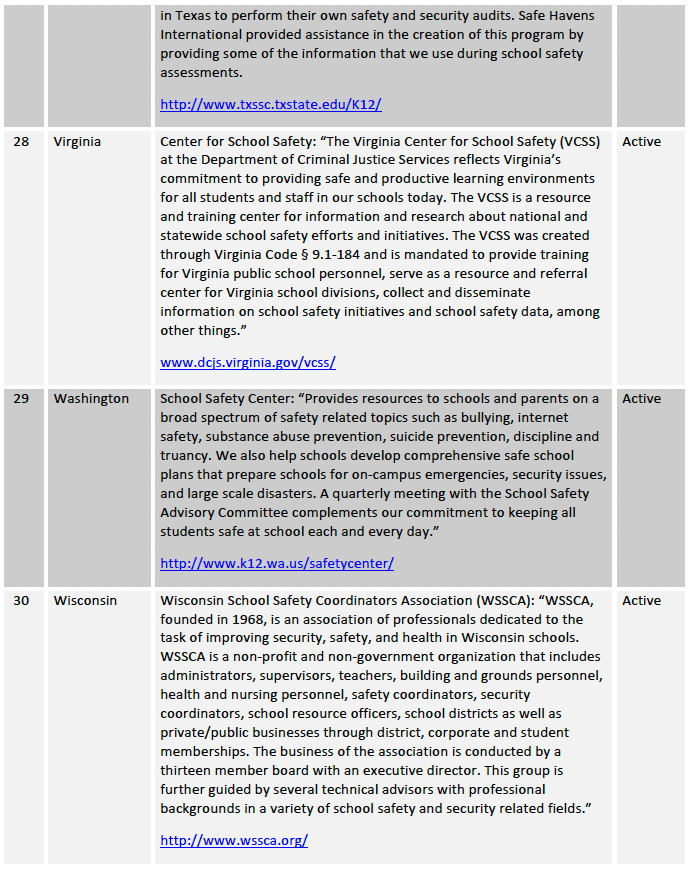
III. School Safety Responses and Approaches by State Agencies
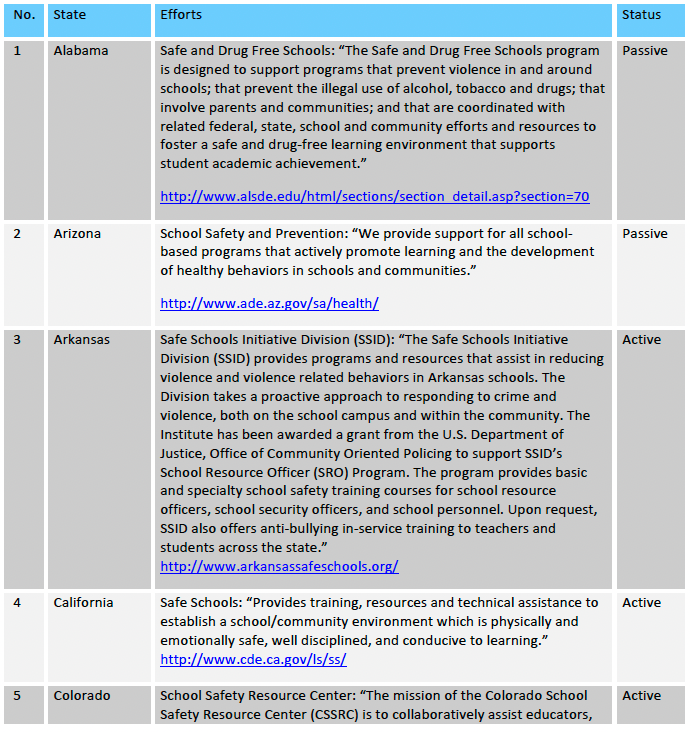
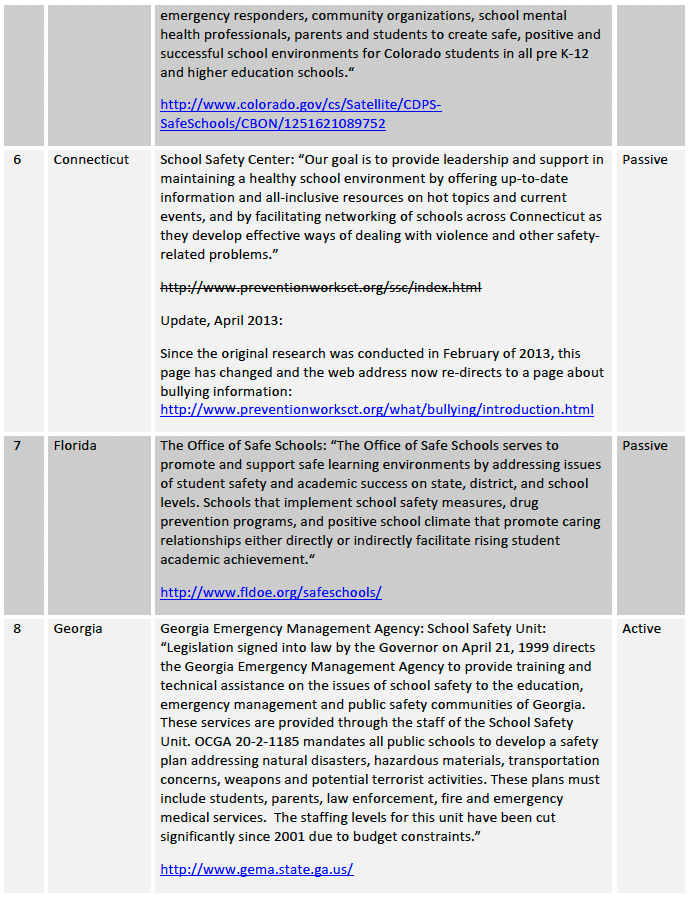
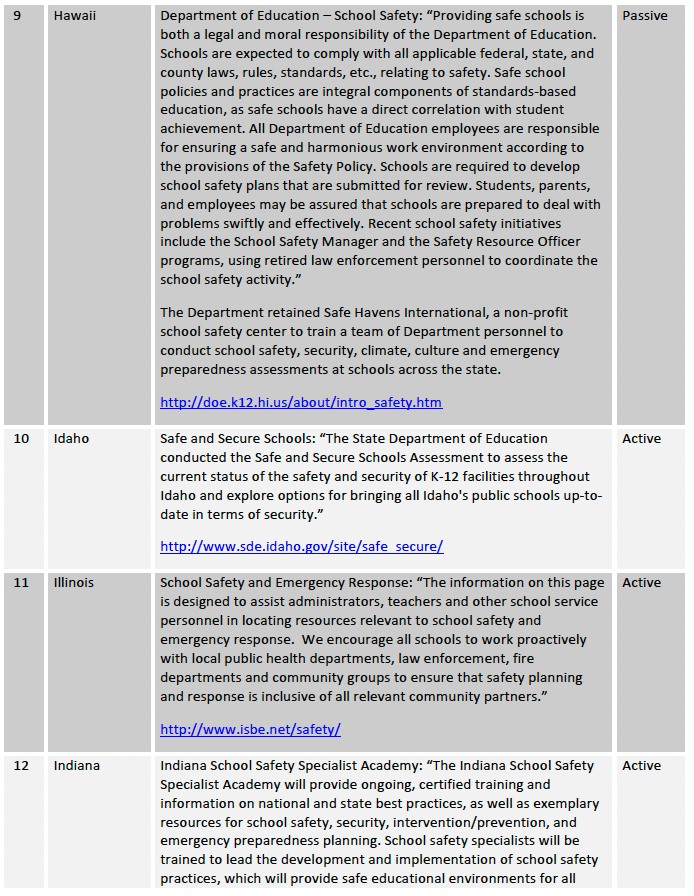
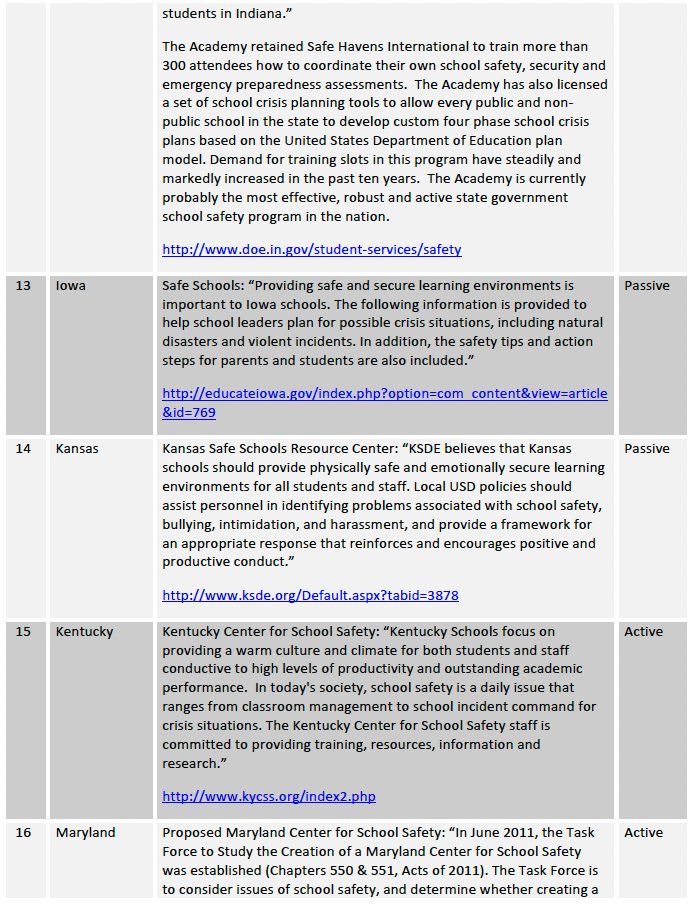
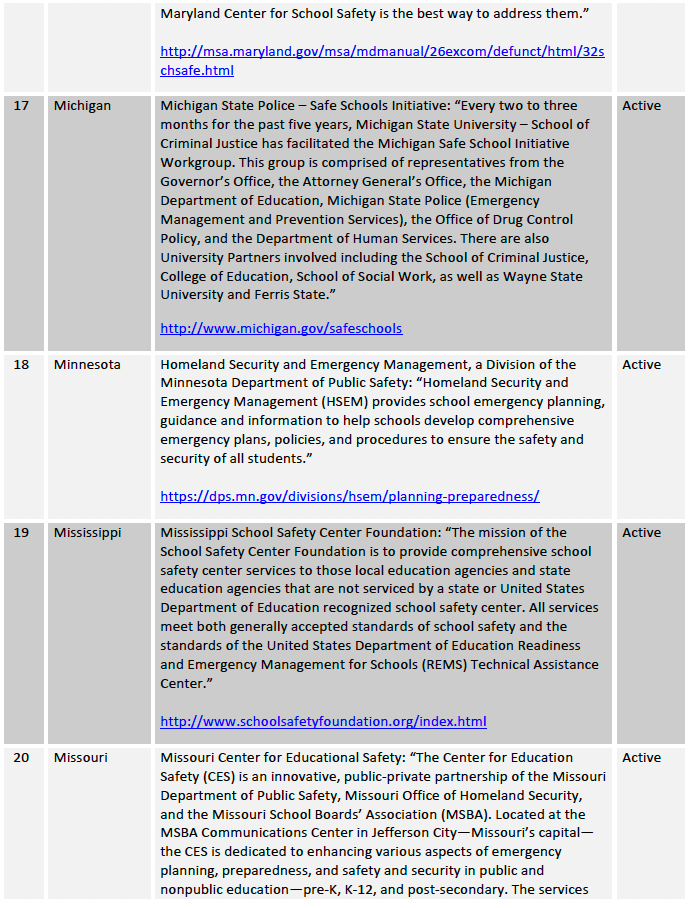
Most state agencies have also conducted school safety efforts. Below is a review of the efforts by the primary agencies responsible for education and safety in different states. We classify these efforts as “passive” and “active”. Passive efforts are those on which a state agency may make resources available to those seeking them or offer minimal training to those interested. Active efforts are those that are required and may include certification. The efforts of each state are up to the states to decide. A state may have established passive efforts because it feels that more active measures are not needed.
IV. School Security and Law Enforcement Officers
In an effort to enhance school safety, many schools utilize security and/or law enforcement officers. School-based officers range from sworn law enforcement officers, sworn law enforcement officers with school-specific training (i.e., School Resource Officers [SROs]), armed and unarmed security officers, and untrained civilians. The National Association of School Resource Officers (NASRO) offers a carefully developed and time-tested training program for school resource officers.
NASRO also offers a variety of advanced training programs for officers who have completed their basic training program. Another private organization offers a training program for school resource officers, but this training is not as well-established as that offered by NASRO. The Georgia Police Academy offers a longer, well-established training program for school resource officers and annual advanced training sessions.
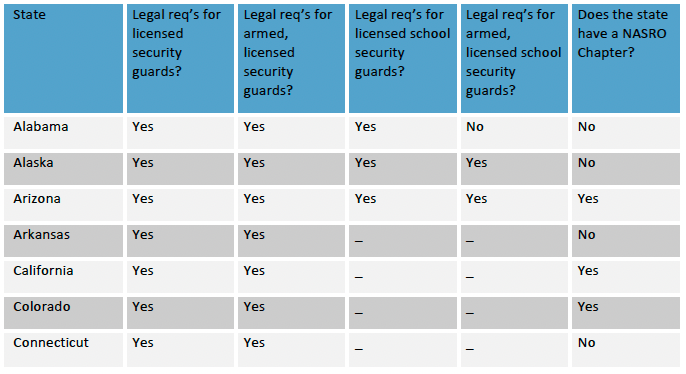
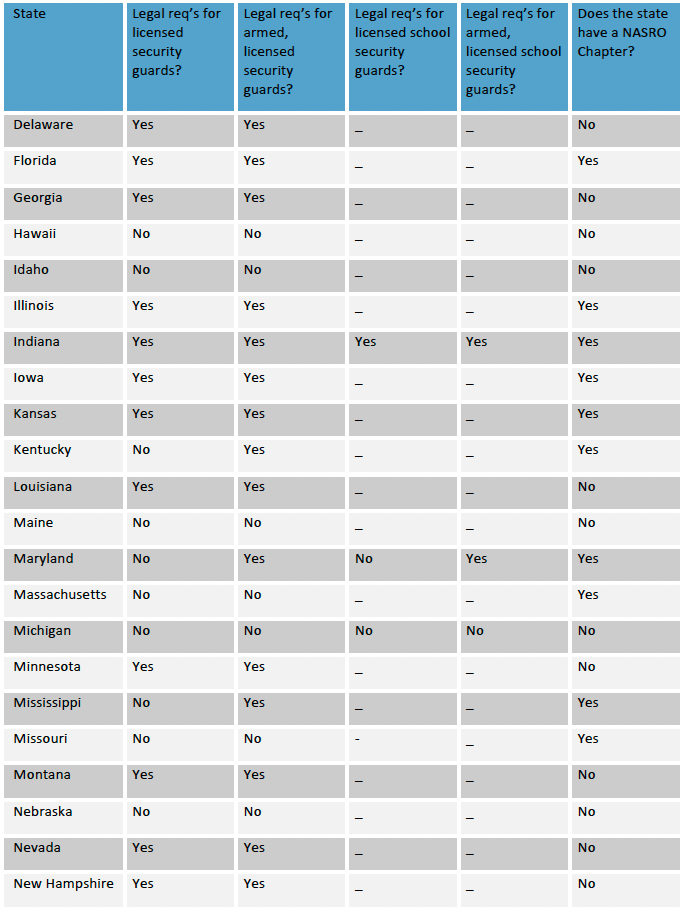
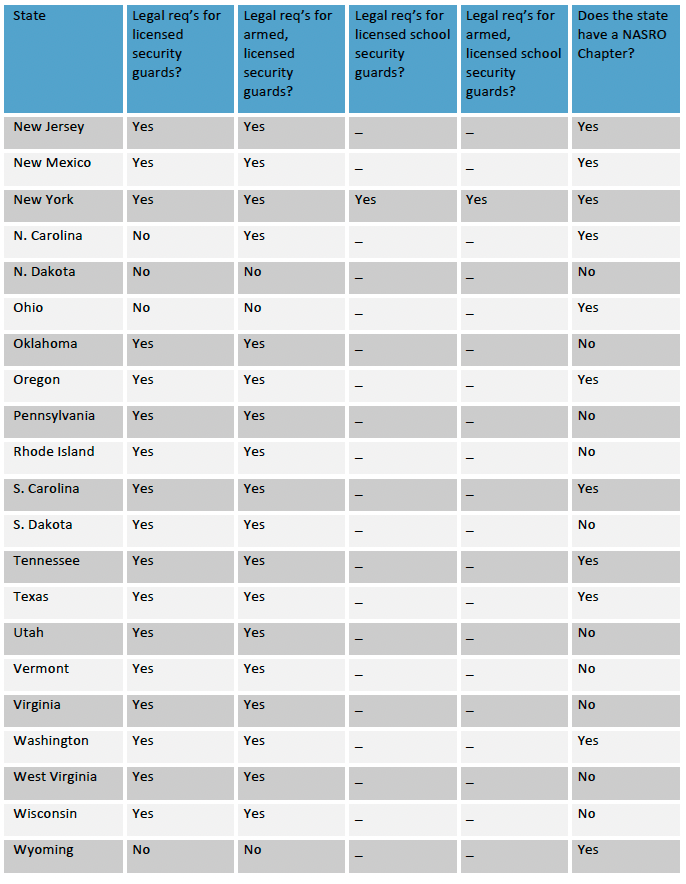
A review of requirements for being a non-sworn security officer for each of the 50 states reveals that the requirements vary from state to state, with some only requiring that an agency declare a person to be a security guard, to others requiring specific training and coursework requirements in order to receive and maintain a state license. The following questions are used in our review:
• Are there legal requirements for licensed security guards?
• Are there legal requirements for armed, licensed security guards?
• Are there legal requirements for licensed school security guards?
• Are there legal requirements for armed, licensed school security guards?
• Does the state have a National Association of School Resource Officers (NASRO) Chapter?
The following table shows the results state by state. A blank indicates that no information was found.
About the co-authors
Michael Dorn serves as the Executive Director of Safe Havens International Inc., a non-profit school safety center. A full-time campus safety practitioner at the K-20 levels for more than 30 years, Michael has authored and co-authored 26 books on school safety, and his work has taken him to Mexico, Central America, Canada, Europe, South Africa, Asia, and the Middle East. A graduate of the 181st Session of the FBI National Academy, Michael also participated in a 14-day fellowship in the State of Israel through a program from Georgia State University to study antiterrorism and community policing. Michael can be reached at mike@weakfish.org.
Stephen Satterly, II, has an Active Shooter certification from the Indiana Law Enforcement Academy. He served in the US Army for 12 years as an Infantry Drill Sergeant and Officer, and has numerous FEMA certifications. He is a 2007 Alumnus of the FBI Citizens’ Academy and is a researcher, author, and expert witness for school safety cases. Stephen can be reached at stephencsatterly2@gmail.com.
Phuong Nguyen has assisted in major school safety assessment projects for the Center for Safe Schools, Pennsylvania Department of Education, the Hawaii Department of Education, the Wisconsin Homeland Security Council, the Indiana Department of Education, and numerous public school systems across the United States. Ms. Nguyen has provided oversight and reporting for school safety assessment projects covering more than 2,000 public, private, charter, independent, and parochial schools. Ms. Nguyen has also assisted with dozens of Readiness and Emergency Management for Schools projects funded by the United States Department of Education.
Chris Dorn has authored and co-authored five books on school safety and published a paper on schools and terrorism in the Journal of Emergency Management, the most widely circulated peer-reviewed journal in the field of emergency management. Mr. Dorn has served as a trainer for the U.S. Office of Homeland Security, FEMA, Israel National Police, International Association of Chiefs of Police, National Association of Pupil Transportation, Bureau of Justice Assistance, and the Bureau of Alcohol, Tobacco, and Firearms, and numerous state departments of education, law enforcement, and emergency management. His book Innocent Targets – When Terrorism Comes to School is used by emergency management and homeland security officials in all 50 states, by the U.S. Department of Homeland Security, and by public safety agencies around the world.
 Stephen C. Satterly, II - Author
Leave a comment