By Stephen Satterly, School Safety Monthly, December 2015
I have had the honor of doing school safety assessments across the United States. One of the questions typically asked during these assessments is whether the school has done any earthquake drills. Much more often than not, the answer is no. This even applies to areas where earthquakes are a real risk. Should your school be concerned with earthquake sheltering? As is often the case, the answer lies in the facts.
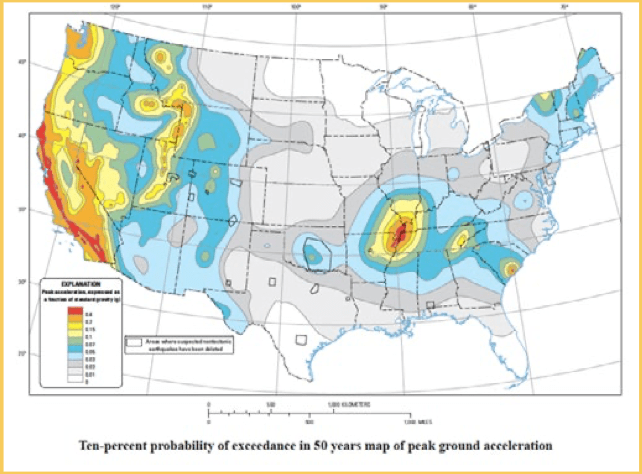
The above map is from the US Geological Survey. It shows the areas of the lower 48 states and the probability of having a significant earthquake. (USGS, 2014)
The map above shows the probability of ground movement each year. The red areas have the highest movement frequency along the San Andreas Fault in California and the New Madrid Fault in Illinois, Missouri, Arkansas, Mississippi, Tennessee, and Kentucky. The Juan de Fuca plate along the Pacific Northwest coast also increases the risk of earthquakes, landslides, and tsunamis. Simply put, these areas have a higher probability of experiencing a significant earthquake in 50 years. Of note, there are relatively small areas of white, indicating a near-zero probability of a quake occurring. Unless your school is in one of these areas, you definitely have at least some risk of earthquakes.
The Great Shakeout website offers excellent resources for schools to help them prepare for earthquakes. The essence of responding to an earthquake is Drop, Cover, and Hold On.
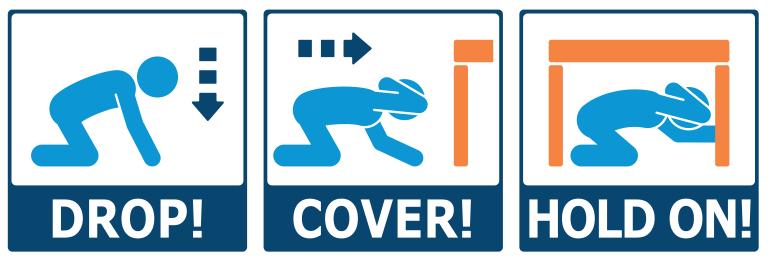
Earthquakes are not easily predicted, and often happen with little warning. When that happens, people need to stop what they are doing and drop to the ground. The USGS recommends dropping and getting under sturdy furniture, such as a table or desk. If you are unable to find this type of shelter, drop to the ground in an inside corner of the building and cover your head and neck. The USGS also warns against the following:
1) DO NOT get in a doorway! An early earthquake photo depicts a collapsed adobe home with the doorframe as the only surviving part of the structure. This evolved into the myth that a doorway is the safest place to be during an earthquake. In modern houses and buildings, doorways do not provide any additional safety, and they do not protect you from flying or falling objects. Get under a table instead!
2) DO NOT run outside! Trying to run in an earthquake is dangerous, since the ground is moving and you can easily fall or be injured by debris or glass. Running outside is especially dangerous, as glass, bricks, or other building components may be falling. You are much safer staying inside and getting under a table.
3) DO NOT believe the so-called “triangle of life” myth!
In recent years, an email has circulated that recommends potentially life-threatening actions, and the source has been discredited by leading experts. It calls for people to take shelter next to a large, solid object. The thought here is that the large object will provide a pocket of shelter should the structure collapse.
The triangle of life might be applicable in instances when a building “pancakes“, that is, collapses straight down. However, earthquakes cause lateral movements, which, given modern building standards, would not lead to pancaking. The best bet is to stop, drop, and hold on.
After the earthquake has ended, get out as soon as possible. The structure you are in may be weakened by the earthquake. Provide triage and first aid for the people in your care. Maintain awareness of your surroundings for potential hazards, such as downed power lines or natural gas leaks. Develop accountability of your people, and be prepared to report to first responders if anyone is missing.
Preparing for earthquakes is simple, but actually responding will not be easy. Earthquake damage is widespread, and you will not be the only one affected. Being prepared means being prepared for the long haul, as help may not be quick in coming. Be prepared!
Stephen Satterly, II, is a senior analyst with Safe Havens International. He is also a researcher and author. He can be reached at stephencsatterly2@gmail.com.
 Stephen C. Satterly, II - Author
Leave a comment