By Stephen Satterly, The Safety Net, January 2013
This has been a rough couple of weeks for Sheepdogs, especially those who watch over children in schools. The rampage attack at Sandy Hook Elementary School has caused the level of fear in this country to rise to new heights. In the aftermath, there have been numerous stories of thwarted school violence plots, students bringing guns to schools, and even an incident where a man in camouflage attempted entry into a school. All of this has whipped our fear into the type of media frenzy we usually experience in the wake of such tragedies. We cannot simply blame the media, as they deliver what we watch, read, and listen to the most often.
This has fueled many intensive discussions on school safety, gun control, and, to a lesser extent, mental health care. These are all much-needed discussions, but fear has clouded many people’s thinking to the point that they are driven more by emotion than by reason.
How does the Sheepdog handle fear?
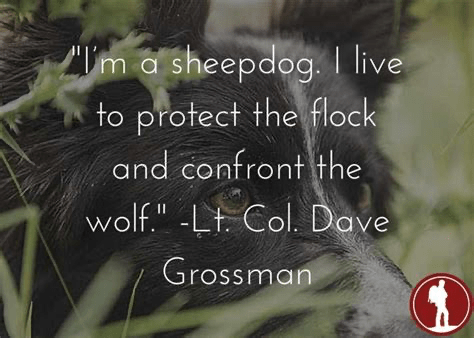
LTC Dave Grossman, who coined the Sheepdog analogy, has studied fear and developed some interesting insights. “When snakes, heights, or darkness cause an intense fear reaction in an individual, it is considered a phobia; a dysfunction; an abnormality. But it is very natural and normal to respond to an attacking, aggressive fellow human being with a phobia-scale response
This is a universal human phobia. More than anything else in life, it is intentional, overt human hostility and aggression that assaults the self-image, sense of control, and ultimately, the mental and physical health of human beings.”
The sheepdog, as well as society, must learn that this fear, as Grossman states, is normal and natural. There is no shame in being afraid. Fear can be a great motivator when controlled.
I’ll guarantee you that the teachers and staff in Sandy Hook were terrified when the attacker stormed into their school. Yet the predominant information we currently have indicates that the school principal, Dawn Hochsprung, lunged at the attacker to disarm him and was killed. Victoria Soto confronted the attacker, lied to him about the whereabouts of her children, and was killed. (Subsequent information during the investigation showed this was not the case. This highlights the problems with early information, which can be incomplete or even incorrect.) Rachel D’Avino, a teacher’s aide, grabbed her special needs student, held him close to shield him from the attacker, and died.
Bravery is not the absence of fear, but the acceptance of fear, and the decision to control oneself in the face of fear. Time and careful analysis will be required to determine whether these acts of valor were effective, but if these reports are true, these educators exhibited real confidence in the face of fear.
Those who protect children should stay up to date on current events, especially those related to schools. Study them, learn the warning signs of danger, and look for them in your own school. Do away with the “It can’t happen here” mentality of the sheep.
Every day, news services report stories of schools where “it did happen there.” So, operate with the mentality that it will happen, and work from there. Grossman’s sheepdog analogy is a very helpful one for those charged with protecting others.
Plan for what will happen, and don’t do it alone. Sheepdogs are better in packs. Work with other sheepdogs and use their knowledge and resources to help with your mission. Once you have prepared your plans, exercise them. Don’t be afraid of failure in an exercise, because that is how you improve your plans. Exercises are the best places to fail. In an exercise, you can learn from your mistakes and suffer no consequences.
We must keep a balanced perspective when it comes to the things we fear most. Remember: school shootings are not now and have never been a leading cause of death in American schools. At the same time, they are sometimes especially catastrophic tragedies that we must address in our efforts to protect students and staff at school.
Being the protector of children is no easy task, especially in today’s world. So study, plan, prepare, exercise, and know that you are not alone, but recognize that the price of failure is too high to bear.
Every day, millions of teachers around the world go forth with the mission of educating and nurturing young people. In many places, these educators also go forth with fear, but they persevere. Let them be an inspiration to the rest of us. School is still one of the safest places to be. Let’s keep it that way.
Stephen Satterly, II, is a senior analyst with Safe Havens International. He is also a researcher and author. He can be reached at stephencsatterly2@gmail.com.
 Stephen C. Satterly, II - Author
Leave a comment