by Stephen Satterly, School Safety Monthly, December 2015
You are outside monitoring your class at recess. You feel a strong wind start up, and look up to see a funnel cloud approaching, maybe 300 yards away. You’re the only adult out there, so what would you do?
The answer is to get them to shelter, but where is that shelter? When the tornado is bearing down is not the time to wonder where to shelter. Preparedness is vital to survival!
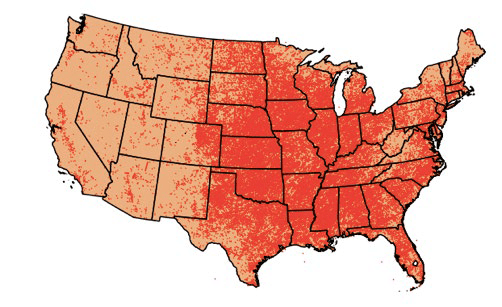
This is a map of the United States that shows all tornado touchdowns from 1950 through 2011. This map was created using the program uDig and a tornado track shapefile from the Storm Prediction Center.
Some steps to take to prepare:
1. Go through your building with people who know about the facility – architects and engineers, and certainly someone from your local emergency management agency. They can review plans and help select the safest areas in your building to shelter in during severe wind events. FEMA has created a document titled FEMA P-431, Tornado Protection: Selecting Refuge Area in Buildings, Second Edition.
2. When a safe area is identified, calculate how much floor space is available. The FEMA recommendation is 2.5 square feet per person, 3.5 square feet for people in wheelchairs. So, after calculating the floor space, divide by 2.5 to get the number of people who can be sheltered there.
3. If there is not enough space for everyone, FEMA recommends using the “best available shelter.” These should be identified prior to their use. Some basic guidelines are to use north-south hallways and classrooms on the north and east sides of the school, away from the prevailing direction of most tornadoes. The idea is to provide the best possible chance of surviving.
Some things to avoid:
1. Wherever possible, avoid exterior walls as large objects may penetrate as they are tossed by the winds.
2. Avoid classrooms with windows, especially on the south and west sides of the school. If classrooms have to be used, have blankets on hand to cover students and mitigate flying debris.
3. Try to avoid east-west hallways, especially those with an exterior door, as they can turn into wind tunnels.
4. Avoid areas with large roof spans, like gymnasiums and cafeterias.
5. Do NOT use second-floor areas! Wind speeds increase with altitude, increasing missile damage from flying debris.
Once safe areas are selected, mark them on a map and keep this on file in your building safety plan along with appropriate notes about why these areas were chosen. This information could be invaluable as staffing changes over time. These areas should not change unless you remodel your building.
Practice getting to your safe areas quickly. If these areas are properly situated, it should take no more than two minutes to get everyone in the building to a shelter area. If it takes longer, find a closer area.
When people are in the shelter areas, there is no recommended position for a person to assume. Some prefer the crouching position with hands and arms over the neck and back of the head, others prefer to sit with their backs to a wall, with their arms over their head. FEMA does not recommend one over the other. Pick one and practice, practice, practice.
Each building should conduct annual reviews of its local risks, including severe weather events like tornadoes, hurricanes, and derechos (Land hurricanes). If severe wind is considered a risk in your area, make sure to properly plan and then practice responding to these events.
Stephen Satterly, II, is a senior analyst with Safe Havens International. He is also a researcher and author. He can be reached at stephencsatterly2@gmail.com
 Stephen C. Satterly, II - Author
Leave a comment