Recovery planning for tornado strikes on schools
By Stephen Satterly, School Planning & Management Magazine (Cover Story), May 2012
You’re standing in front of the ruined shell of your school, the day after the tornado came through. The event has forever changed your life. Your mind keeps replaying snippets of memory from the day before: the overwhelming pressure on your ears, the shrieking of torn and twisted metal, the screams of terror from students and adults alike, the awesome roar that seemed to come from everywhere at once. Fortunately, no one was hurt by the devastating storm, but the building has been severely damaged. Now you stand before your school and numbly wonder what to do now.
Recovery is a phase of emergency management that often receives insufficient attention. Yet, like the response phase, the time to make plans is not when the incident occurs, but before. There are necessary elements of a recovery plan that should be developed, exercised, and corrected before being used.
The first priority is life safety and well-being. Before allowing people to reenter the building, consideration must be given to the fact that it is now a dangerous place, and no one is allowed entry unless the Incident Commander has cleared them.
People who are allowed to enter should be cautioned against possible physical and emotional trauma associated with reentry. Climbing through debris and coping with the changes to a building where you have worked can be a very draining experience. Be alert for signs of exhaustion, and take frequent rest breaks. It is important to drink plenty of water and to eat well. People entering the site should wear sturdy boots, leather gloves, a hard hat, eye protection, and, where needed, respiratory protection.
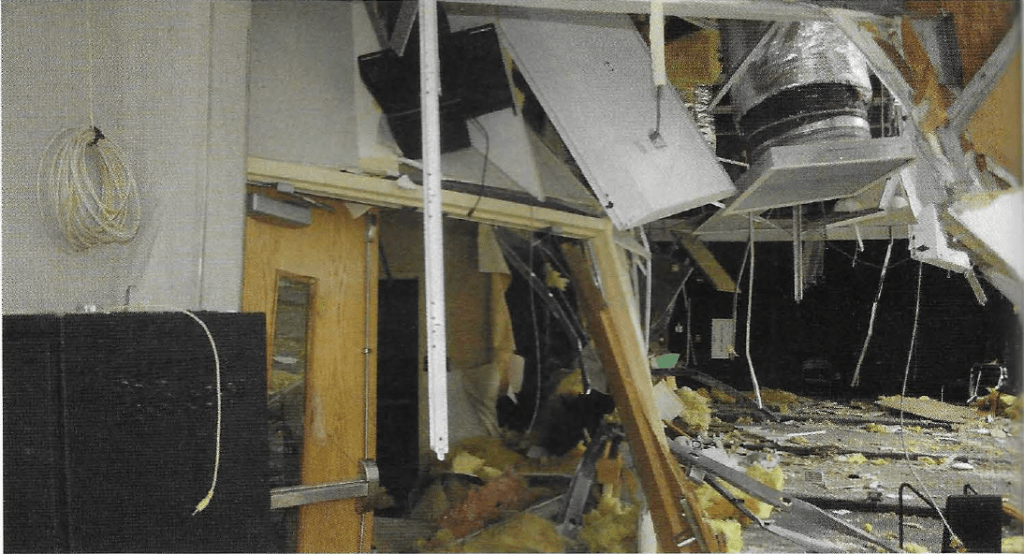
Unbelievable devastation. There won’t be anyone singing in this choir room at the Henryville (Ind.) High School for quite some time. An EF4 tornado struck the southern Indiana town on March 2, 2012, destroying much of the town and damaging several school buildings. Recovery efforts began immediately, but it will be quite a while before anything resembling “normal” returns to this part of the country.
Broken glass, masonry, and items hanging from the ceiling can pose hazards. When stretched, metal-wiring conduit can become as sharp as razor wire. If something looks unsafe, don’t chance it. Have professionals check it out before allowing people to enter.
You should keep in mind the following:
• Use a battery-operated flashlight to inspect your building. Turn it on outdoors to prevent a spark.
• Be wary of wildlife and loose pets. They may be in a defensive mode.
• Only use your phone to report a life-threatening injury.
Your insurance company will have companies you can hire for the restoration process, as well as for repair and/ or rebuilding. It will be in your best interests to have frequent, regular meetings with the insurance agent, restoration management, and school administrators to monitor progress. Make sure that whichever company is retained properly disposes of debris, especially hazardous debris. Unfortunately, relationships with insurance companies do not always go well, so do not expect them to take care of everything the way you want. In Henryville (Ind.), the school corporation ( district) lost two buses owned by a private company to the storm, and the insurance company offered them much less than the buses were worth. The meetings mentioned earlier will help keep the lines of communication open.
As an educator, your primary focus is on the students in your care. They are vulnerable not only to physical danger but also to psychological trauma. Therefore, your recovery plan should include a system to help them deal with the incident and return to normal. Dr. Sonaya Shepherd, a recovery specialist with Safe Havens International, reminds us, “After a traumatic event such as a natural disaster, traumatic stress reactions can occur. Reactions in children, such as regressive behavior, separation anxiety, and fatigue, may be indicators of emotional trauma and require crisis intervention or sometimes long-term care from a professional.
A child’s risk of psychological trauma from an incident is normally based on four risk factors:
- Direct exposure to the disaster. This can come from being evacuated, seeing others hurt, or being in fear for their life.
- The loss or grief of losing family, friends, or pets.
- Secondary stress from temporary displacement or major life changes.
- Prior exposure to a disaster or other traumatic event.
Children also take cues from the adults around them. The adults remaining calm and in control during an incident are the best source of support for the children. Angel Perry, a Henryville bus driver, remained calm as she returned to the school ahead of the tornado. Her kids listened to her instructions and survived.
Following a traumatic event, your students may be concerned about it happening again, losing a loved one, or being separated from their family and friends. Don’t be dismissive, and don’t lie. Listen to their concerns and share how their school is protecting them. Keep the discussion age-appropriate. Younger children will need less elaboration than older ones. If the child has trouble communicating, have them draw or use other means of expressing their concerns. Draw on your connection with the child to find the best way to communicate. All schools should have a written mental health recovery plan, and this plan should be implemented after any incident.
Educators should encourage their students to talk about what happened and should actively listen. They should answer any questions factually. Give them specific tasks to help restore normalcy at the school. Re-establish daily routines to bring order back to the chaos of their lives. News stories in the various media can heighten stress and anxiety, so schools should reduce exposure to them while at school.
Children are resilient. All they want is for things to get back to normal. As educators, it is up to us to make that happen. This article is a brief introduction to the recovery phase: It is up to you to dig further, develop a good plan, test it with exercises, and correct any deficiencies you find. FEMA has excellent free resources to assist you. Your state department of education and/or emergency management agency may also provide quality, free resources.
In 2002, an EF3 tornado struck a middle school located directly behind the elementary school where I was serving my first school administrator position. The tornado then came within 50 yards of my school, tearing off the roof ventilators and exposing the children within to the elements. We were out of school for the rest of the week. When the children returned, our staff were lined up outside to greet them. The bright smiles on the children’s faces and the tears on the teachers’ faces told us that everything would be okay. We had survived the storm, and we were stronger and closer for it.
Stephen Satterly, II, is a senior analyst with Safe Havens International. He is also a researcher and author. He can be reached at stephencsatterly2@gmail.com.
 Stephen C. Satterly, II - Author
Leave a comment