By Stephen Satterly, School Safety Monthly, January 2015
In a training video, a gunman skulks into a classroom, and immediately the valiant students respond by throwing anything at hand at the gunman. They then swarm him like a pride of lions taking down a gazelle, and handily take him down while the rest of the class escapes with their lives. Except for the hapless gunman, who is going to jail, they all live happily ever after.
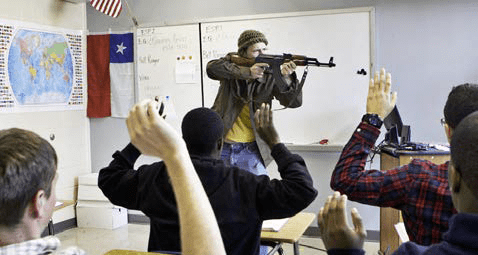
While being used to illustrate a point, the training video shows a teacher and students who are clearly anticipating what is about to happen, and a gunman who is unusually slow to react, in contrast to real-life aggressors. The situation illustrated by the video is so contrived and unrealistic that it might as well be a fairy tale.
Setting aside the fact that there is a very low probability of a shooter ever assaulting any specific school, let alone classroom, the tactic being described in the video, distraction followed by close-quarters combat (using physical force to overwhelm and restrain or eliminate a threat), should be examined closely. Any training in responding to situations should include training on the decision-making process, which in the law enforcement field is called Use of Force Training.
Distraction Theory
The act of throwing items at the gunman is based upon Distraction Theory. This approach is reliant upon diverting the attention of the gunman from their goal of shooting victims because their startle reflex is triggered by objects suddenly approaching their face. Police and military forces use distraction tactics when they use “flash-bang” grenades before entering a room or building. This is an extreme form of distraction theory as it physically overwhelms the senses of anyone in the room. When a police tactical team or military special operators use distraction techniques for a dynamic entry to a space occupied by an armed aggressor, they are equipped with body armor, advanced weapons systems, and have extensive practice as a team, which allows them to rapidly advance and apply significant violent force to attempt to neutralize the aggressor with gunfire. Even then, aggressors are still sometimes able to kill before being stopped by gunfire.
One significant question regarding the use of this form of distraction is whether throwing items may not be enough to distract the gunman. While multiple items are in the air, they may or may not be in the face of the gunman, who is focused on seeking a target. This focus will keep the aggressor on task, unless an object finds its way to the aggressor’s eyes, at which point the instinctive response of flinching may or may not activate. In any case, the stimulus of throwing items toward the gunman will most likely not be overwhelming in an actual event because it is likely that many students will freeze or be too slow to react without extensive training and practice. The next major concern is that the distraction may not last long enough, and the level of force that lightly trained and practiced students and staff can apply is far lower than that achieved with gunfire. While police tactical officers do sometimes subdue aggressors by other means, they receive far more training and practice than is being afforded by current options-based active shooter training programs.
Advocates of this approach often assert that using these tactics is better than “doing nothing.” They also typically utilize inaccurate and highly emotive assertions that not using this approach leaves people to die while “cowering in a corner.” One response to that is: are we training people to do something better than nothing, or are we training them in effective decision-making under stress so they can use proven, correct tactics successfully? This notion that we should focus our energies on such desperate tactics is especially disturbing when we do have other approaches available that are far less dangerous, easy to apply under stress, and which offer greater opportunities for survival. Safe Havens International has released a series of free HD training videos that outline several of these concepts, based on the highly researched book Staying Alive – How to Act Fast and Survive Deadly Encounters, which covers them in depth.
Use of Force
Here are a few questions for the many law enforcement officers who advocate these programs:
- Are you training laypeople in the way you were trained?
- Do you focus most of your training time to learn how to react to a single type of incident by using close-quarter combat techniques rather than an array of situations?
- Do law enforcement officers train to employ the same type of force in every situation they encounter?
Training in only one way is not proper tactical training. This is not done in the U.S. military, nor is training typically done this way in U.S. law enforcement agencies. Let us examine more closely why these questions are so important. Change the above scenario to a student entering a classroom to kill himself or herself. If even one student were to throw an object at the student with a gun, what is likely to happen? How will school and police officials who provided the training defend the approach in the court of public opinion or in a court of law? A person who is attacked will likely react defensively, leading to the use of a gun. Change the scenario now to a gunman pushing a hostage into the room ahead of him or her. What is likely to result if several students rush the aggressor or throw objects at them? While active shooter incidents receive intensive media coverage, they represent only a very small fraction of school weapons incidents and fatalities. For example, suicides on campus occur eight times more often and result in twice as many deaths on school property. For more information on school data, see the report “Relative Risks of Death in U.S. K-12 Schools“ on the Safe Havens International website.
Overly simplistic, one-dimensional training is counter to how military and law enforcement personnel are trained. Why should we expect educators with no other use-of-force training or experience to be able to rapidly size up and react to various situations if we focus their training on only one type of extraordinarily rare type of weapons incident? Without providing them with scenario-based training for the weapons incidents, they are much more likely to experience that they will be woefully unprepared for the types of incidents that cause most of the violent deaths in American schools.
Proper law enforcement training reinforces the tactical decision-making process by providing the officer with similar scenarios with different tactical characteristics that help the officer learn not only how to decide, but when to act. This type of training is lacking in current “options-based” responses. Just as officers who are not run through “no shoot” scenarios are more prone to shoot when they are not supposed to, singular outcome active shooter training is likely to condition people that anyone with a gun on campus is an active shooter.
Training People to Decide
Running, hiding, or engaging in close-quarters combat all require tactical decision-making. Current “options-based” responses only teach the rudiments of the ‘how’ of responding to an armed threat, but provide little, if any, training on the ‘when’, in contrast to situations that do not involve an active shooter. This may endanger not only the person making the decision for themselves but also expose others to increased danger.
Law enforcement trainers and all who are responsible for training others in tactics need to assess how they are training people. They need to train for both the ‘how’ and the ‘when’ of tactics. Utilizing tactics such as distraction theory may be appropriate in some specific but rare situations, if people are adequately trained in when to apply them and can practice these skills extensively.
If we are truly concerned about protecting people, we will give them all the tools they need to protect themselves, including the knowledge of when – and when not – to use them.
Stephen Satterly, II, is a senior analyst with Safe Havens International. He is also a researcher and author. He can be reached at stephencsatterly2@gmail.com.
 Stephen C. Satterly, II - Author
Leave a comment