by Stephen Satterly in School Safety Monthly, March 2015
Springtime in the U.S. heralds the arrival of the major tornado season. It also heralds the age-old question for school safety leaders, “Where do we go for shelter in a storm?” The answer to that question comes from the Federal Emergency Management Agency (FEMA) and relies on the All Hazards approach to school emergency preparedness.
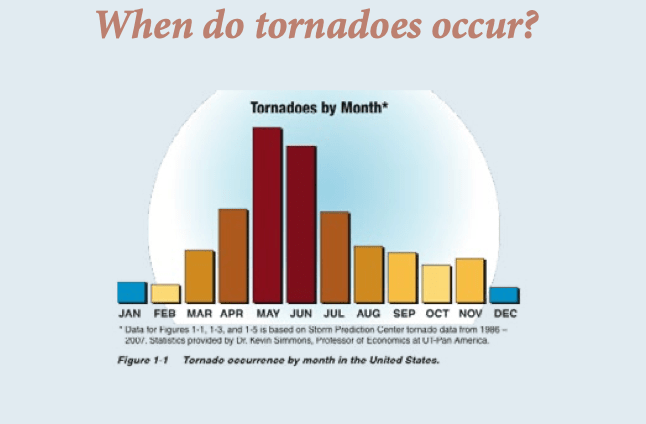
The above chart shows the most critical months for tornado occurrences. Remember that
tornadoes can occur in any month, but are more likely to occur from April through July. Also
note that in the South, there is a secondary tornado season from October to November.
Source: NOAA
Risk Assessment
As with any other threat to your campus, the first step is to find out if tornadoes or severe wind events are a threat to your school. FEMA has created a resource that can help: FEMA-431.
Best Available Shelter
Few schools have FEMA-approved tornado shelters. They offer near-absolute protection from EF-3-strength tornadoes and enhanced protection from stronger tornadoes. Few schools have FEMA-approved tornado shelters. FEMA-361 offers guidance on constructing these safe rooms and “hardened” areas for use as shelters. Most schools, however, rely on “best available shelter” areas.
According to FEMA, a “best available shelter” area is a space in a building identified by a qualified architect or engineer as likely to offer greater protection during a severe wind event. Since they were not designed to withstand severe wind events, people sheltering in these areas may be injured or killed, but they are safer than other locations.
Steps to determining your shelter area:
- Have a qualified architect or engineer assess your building and identify “best available shelter” areas, or your tornado shelter, if your school has one.
- Identify how many people need shelter. FEMA has determined that a person needs 2.5 sq ft of space to shelter. A person in a wheelchair will need 3.5 sq ft. Multiply the number of people by 2.5, add in the number of wheelchairs multiplied by 3.5, and you will have the square footage of refuge area you will need.
- Compare the square footage of the available “best available shelter” to the required square footage. If you do not have enough refuge area, there is an issue that requires mitigation.
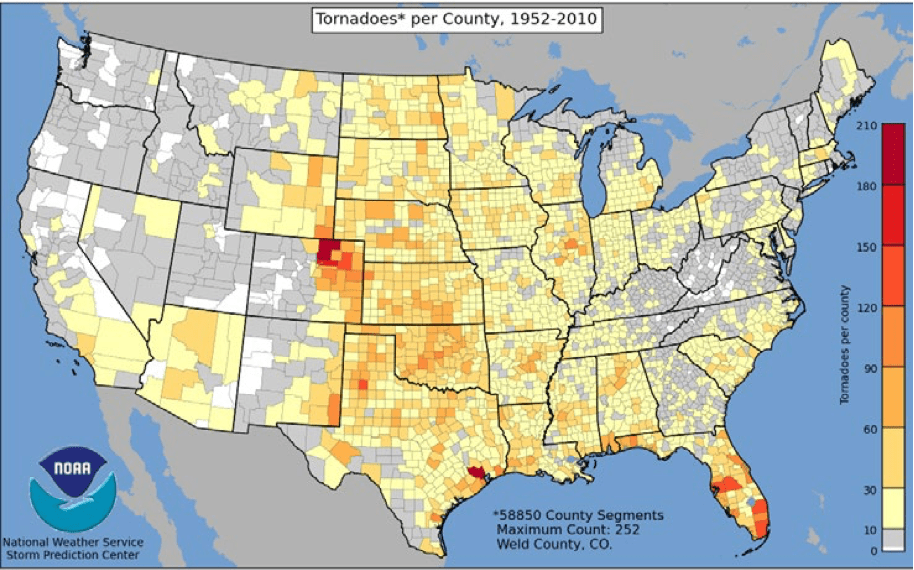
The above information is derived from historical data and National Oceanic and Atmospheric Administration data and shows the number of tornadoes that have occurred in each county
between the years of 1952 and 2010. This is a very useful resource for school safety leaders. If
your school is located in a region that has seen a large number of tornadoes, chances are good
that one will occur again. It is also important to look at the magnitude of tornadoes that have
taken place in your area, since a lower frequency of tornadoes can still create high risk if those
that do occur are very powerful.
Hallways
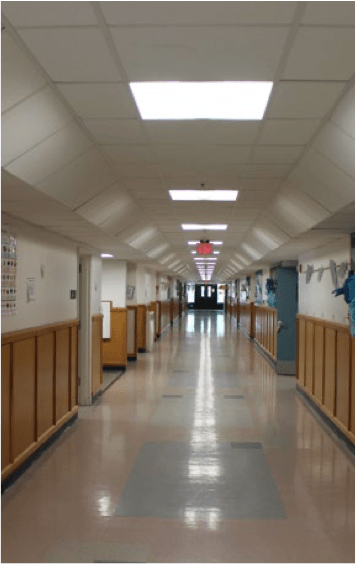
After the destructive tornadoes in Joplin, MO, and Henryville, IN, there was a movement to avoid using hallways as tornado shelters. This approach can increase danger to occupants because the hallway may be the best shelter area for that building. A school following FEMA’s recommended approach may have identified the hallways as its “best available shelter.” If that is the case, moving them from the hallways to another area of the building can increase the danger, as they are moving to a less secure area within that building.
On May 20, 2013, Moore, OK, was struck by a monster EF-5 tornado with some of the highest wind speeds ever recorded. Seven school children and a teacher were killed in the Plaza Towers Elementary School when a wall collapsed on them. The school is being rebuilt with a FEMA-designed storm shelter.
The upcoming tornado season puts thousands of schools at risk. While many schools do not have the resources to build such shelters, the steps above can help mitigate tornado damage in most buildings. The time and effort needed to do this are well worth the improved safety of staff and students.
Stephen Satterly, Jr. is a prolific writer and a senior analyst with Safe Havens International.
 Stephen C. Satterly, II - Author
Leave a comment