by Stephen Satterly, published in Campus Safety Magazine, April 2, 2018
Schools should conduct hazard analyses, space calculations, and site assessments so that everyone on campus can locate the best available tornado-sheltering options.
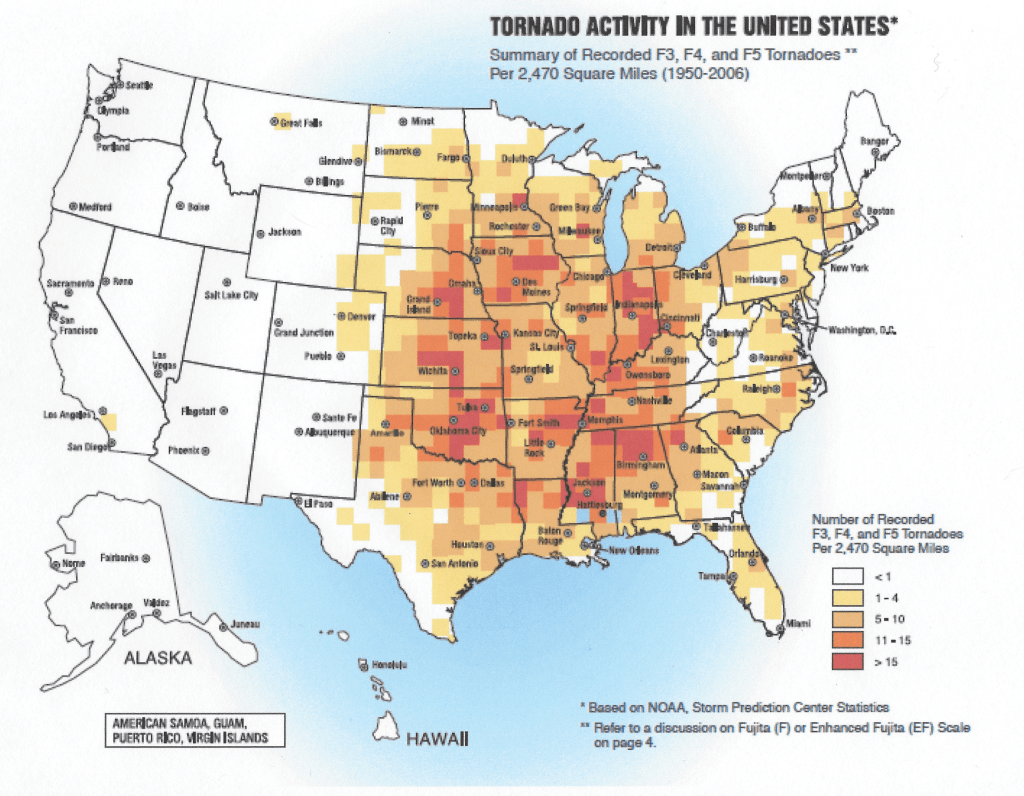
Since tornado warnings began in 1950 and tornado watches started in 1952, 57 students and staff members have died in severe storm events at schools. Fifteen deaths occurred in the last two incidents; eight died in Enterprise High School in Enterprise, Ala., in 2007, and seven died in Plaza Towers Elementary School in Moore, Okla. in 2013. Tornadoes are deadly and unpredictable. Preparing for them requires research and work.
During school assessments across the United States, school administrators have asked many questions about tornado protocols. In schools without tornado plans, leaders wondered if they should have them. In schools that had them, leaders wondered if they were doing things correctly.
A proper tornado protocol will offer the best available shelter for everyone. Campus leaders should conduct a realistic hazard analysis and space calculations, a site assessment, and an exterior assessment. The end goal is a site map showing the facility floor plan, the locations of the shelter areas, and exterior hazards. This assessment process requires working with public safety officials, architects, and engineers.
The Federal Emergency Management Agency (FEMA) provides resources to help facilities prepare for tornadoes. FEMA P-431, Tornado Protection: Selecting Refuge Areas in Buildings, is a free download on FEMA’s website. FEMA-361, Safe Rooms for Tornadoes and Hurricanes: Guidance for Community and Residential Safe Rooms, has more resources. It is also available as a free download.
Hazard Analysis and Space Considerations
Protocol development starts with an analysis of potential hazards. Figure 1 above shows the occurrence of EF-3, EF-4, and EF-5 tornadoes in the United States from 1950 to 2006. Smaller tornadoes are even more widespread. With local tornado events, the county or state emergency management agency has more precise data on local hazards.
If school leadership determines the probability of a tornado is high enough to warrant developing a protocol, then the next step is to determine the space required to shelter everyone in the building. FEMA guidance is to provide space for everyone in the building, including visitors and those with special needs. The following have been provided as guidelines:
- Occupants, standing and sitting: 5 square feet per person
- Wheelchair users: 10 square feet per person
- Bedridden children or adults: 30 square feet per person
Example Calculation of Required Refuge Area Space
A high school has 1,260 students, 4 of whom use wheelchairs; 55 faculty members; and 4 custodial and maintenance workers. At any given time, there can be up to 10 visitors. Planners calculate the required refuge area space by identifying all groups of occupants and their refuge space needs:
1,325 Occupants @ 5 sq ft each = 6,625 sq ft
4 Wheelchair users @ 10 sq ft each = 40 sq ft
Total = 6,665 sq ft
This space can be divided into several shelter areas. (Source: FEMA-431)
Assessments Reveal Building Strengths and Weaknesses
An EF-5 tornado that struck Joplin, Mo., on May 20, 2011, destroyed 20 percent of the town and damaged 75 percent of the buildings. Video footage of tornado winds in a high school hallway prompted a school superintendent to state he would never again use hallways as shelters. This blanket statement, while understandable, violates a precept of emergency management. Leaders should tailor emergency planning to the individual facility.
When planning for a tornado, school leaders must know their building’s strengths and weaknesses. This phase of protocol planning requires an architect or structural engineer and the facility’s blueprints. There are specific structural features to look for when designating a shelter area.
A floor below ground provides safer shelter areas. The higher one goes in a building, the stronger the storm winds. A building assessment will identify the following protective elements:
- Interior partitions: These are walls that are securely attached to the floor above and below. Interior partitions with windows are dangerous.
- Short roof spans: Spans are the load-bearing part of the roof. Spans longer than 40 feet are subject to catastrophic failure in a tornado (think gymnasiums and cafeterias). Spans of 25 feet or less are ideal.
- Rigid frames: Buildings with heavy steel or reinforced concrete frames connected for lateral and vertical strength are superior to buildings that contain load-bearing walls.
- Poured, reinforced concrete walls: These types of walls are the strongest. Regardless of the type of wall, the supports should be secured to the floor and roof systems.
School officials should look for these are hazardous elements during the assessment:
- Long span roofs: Rooms with high ceilings typically have long roof spans. These rooms should be avoided, as the overpressure caused by the tornado will lift the roof and collapse the walls.
- Lightweight roofs: Steel deck, gypsum, lightweight insulating concrete, cement wood fiber, wood plank and plywood roofs usually will be lifted and partially carried away while roof debris falls into the room below.
- Heavier roofs: Precast concrete planks, channels and tees roof-types may be lifted, move and then fall. If supporting walls have collapsed, the roof may fall onto the floor below, killing or seriously injuring anyone there.
- Windows: These are subject to wind and missile damage. When they give out, the broken glass becomes sharp missiles that can cause serious injury or death.
- Unprotected hallways: While not all hallways are dangerous, some are, specifically, hallways with unprotected entrances facing oncoming winds. A reinforced wall in front of these entrances can help protect them.
- Loadbearing walls: These walls are the only support for floors above or the roof. If the wall fails, the floor above or the roof, fails too.
- Masonry construction: These types of walls are usually not vertically reinforced and can fail under the high horizontal pressures of a tornado.
Don’t Forget to Also Assess the Building’s Exterior
Once campus leaders complete the building assessment and identify shelter areas, they should do an exterior assessment. This assessment examines factors outside the building that could negatively affect the shelter areas. This assessment does not require an architect or engineer, but it is advisable to have assistance from public safety personnel.
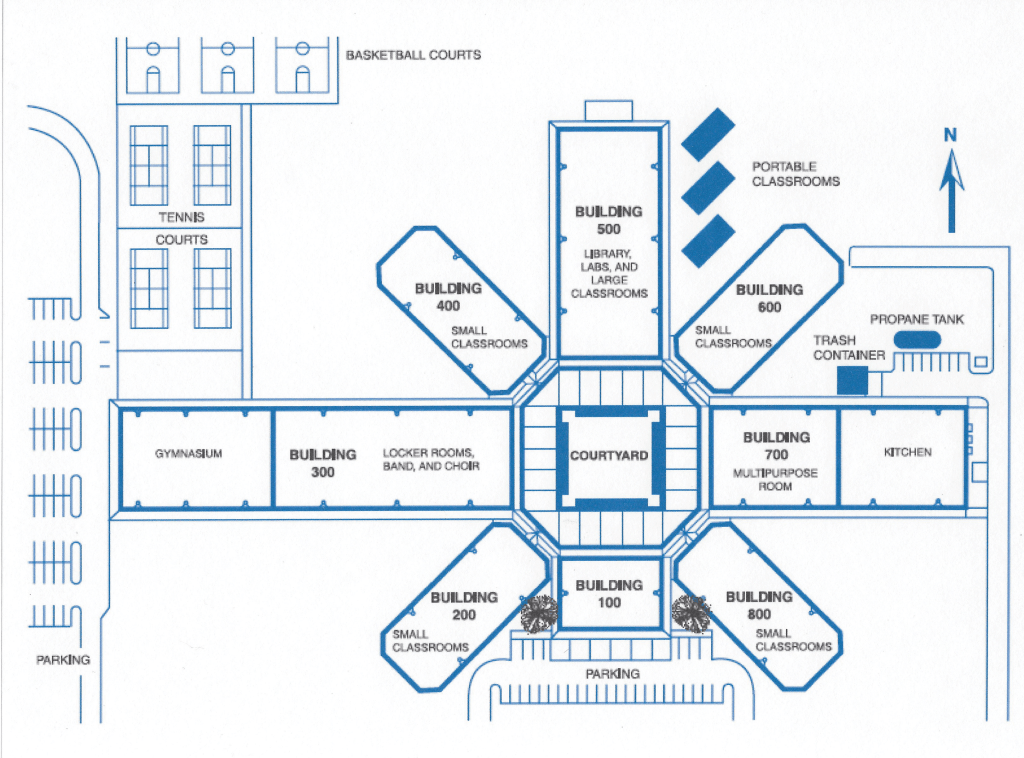
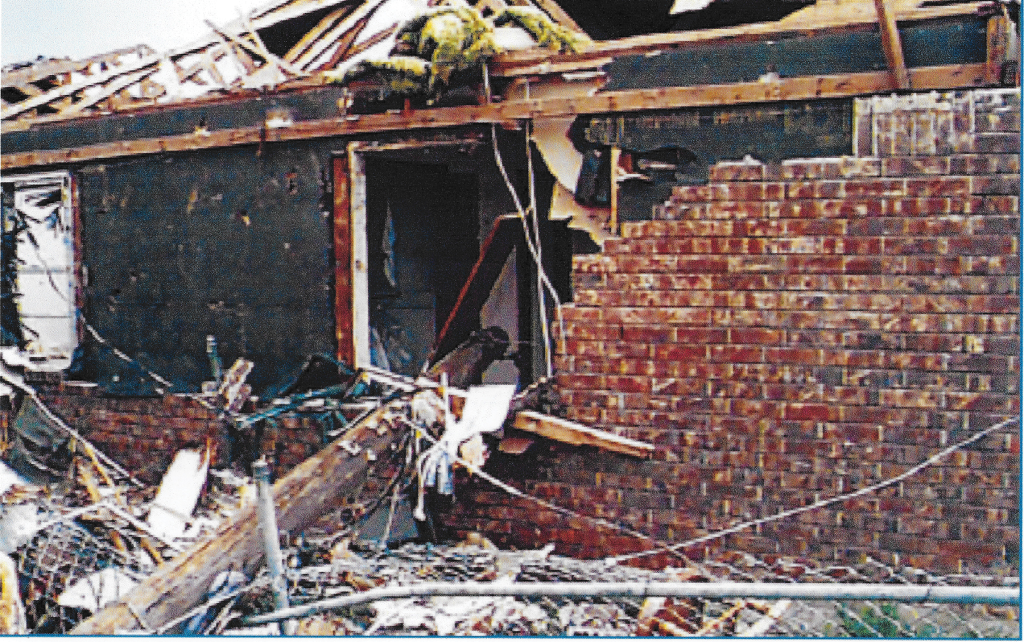
For this assessment, the leader and their team inspect the grounds and identify trees with diameters greater than 6 inches. They should also identify light poles, flagpoles, power poles, masonry chimneys, electrical transmission towers, and communication towers. The goal is to create a site plan and place these objects on it. (See Figure 2) This plan should note the heights of these objects and the subsequent fall zones they create. The best available shelter areas should not be within or next to the fall-down zones because falling trees, poles, chimneys, and towers can cause localized building damage (See Figure 3).
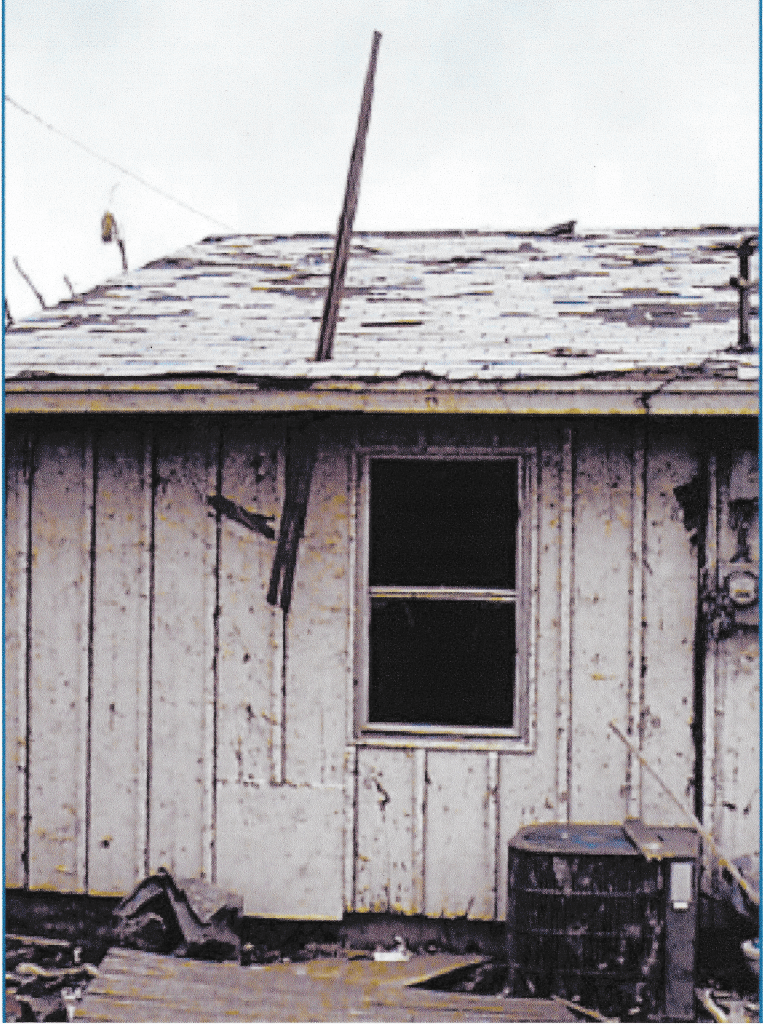
Another consideration is vertical missile damage. This is debris that falls and penetrates the roof (See Figure 4). This is another reason to avoid the use of upper floors.
FEMA-361 includes a best-available-shelter checklist that campus officials can use to verify that the selected areas are the best available in the building. FEMA P-361 also includes information that can help building administrators improve the effectiveness of their selected shelter areas, such as signage and operations plans.
Architects, Structural Engineers Can Help
Tornadoes are dangerous, complex, and unpredictable storms. Preparing for them is more complex than just deciding what hallways to use. Planning for a tornado protocol, like any other hazard planning, requires a realistic risk-based approach. It is a collaborative effort, with members providing their expertise to the process. School leadership can use this process to get to know their building better and learn where it is strongest and weakest.
Having an architect, structural engineer, or other licensed professional who can examine the building is the key to a successful assessment. This not only helps with understanding the building and finding the best available shelter areas, but also reduces liability. The goal is a well-researched sitemap that includes all hazards and the best available shelters.
Many schools are not designed with shelter areas in mind. This makes the best available shelter model an imperative. The perfect shelter is one built to FEMA specifications, but that is a rare find in schools. The majority of schools have to rely on the best available shelters. If you are in an area prone to tornadoes, the time spent on a proper assessment will be worth it. Your people deserve no less.
Stephen Satterly, II, is a senior analyst with Safe Havens International. He is also a researcher and author. He can be reached at stephencsatterly2@gmail.com.
 Stephen C. Satterly, II - Author
Leave a comment