Originally posted in The Safety Net, Volume 2, Issue 3, in April 2012
Tornadoes are among the most violent types of storms in the world, with winds often exceeding 200 mph. They can wreak incredible havoc on schools and communities, and can change lives forever. The string of deadly tornadoes in the spring of 2011, followed by this year’s deadly season, has had the positive side effect of generating renewed interest in tornado procedures for schools.
Having survived an EF3 tornado at my school several years ago, I know firsthand what it’s like to experience severe weather and why preparedness is critical during these times. This article lists basic guidelines for tornado preparedness and response, as schools will vary in their needs. Be sure to modify these based on your local needs and discussions with key stakeholders. I do want to point out that Safe Havens International assumes no liability for these measures – but these tips are definitely a good starting point for your own planning.
Keep an Eye on the Sky
If a tornado watch is issued, conditions are right for tornado formation, and you should be in a heightened state of alert. Curtail outdoor activities, monitor weather radar, weather radios, and local media to track storms, and have your staff locate their emergency kits and equipment so they can be grabbed at a moment’s notice. Review the locations of your best possible storm shelter areas and the routes to get to them. Transportation staff should be notified and placed on alert.
Don’t let clear skies fool you into a false sense of security. Super cells and squall lines can have powerful downdrafts that can reach up to 70mph, and appear miles away from the storm. An example of this is the wind that caused the 2011 Indiana State Fair Tragedy. The actual storm was miles away, but the high winds suddenly appeared, collapsing the stage, killing seven people, and injuring 43.
A tornado warning means that a tornado has been sighted or indicated by weather radar. If you hear this warning, take shelter immediately! Look for the danger signs in the sky: a dark, often greenish sky, large hail, or a large, dark, low-lying cloud, especially if you notice cloud rotation, and/or a loud roar, similar to a freight train. If you find yourself outside, get into a low-lying area or dry ditch and lie flat.
Seek Assistance from Local and State Public Safety and Emergency Management Personnel in Developing Your Plans
Local and state public safety agencies can provide highly qualified assistance, and their services are typically free. Take the time to ask for their assistance, and you will be better prepared for it. You can also reduce your exposure to civil liability by seeking their assistance.
‘Best Available Shelter’
Without a FEMA ‘Safe Room‘, you will need to find the ‘best available shelter’. Many schools are not designed with tornado sheltering in mind, so you will have to do the best you can.
Once you have identified an area as a best available shelter, calculate the square footage of the area, and subtract any unusable space that would interfere with someone using that part of the floor. This gives you the usable space in that area.
Keep in mind that people will be sitting on the floor in the “duck and cover” position. As part of your planning, you should take into account that FEMA considers two hours the maximum occupancy time, although it may be longer.
How to Calculate Usable Space for Sheltering
You will need to know the maximum number of people in your building. Take this number and multiply it by five. For each person in a wheelchair, multiply by 10. The resulting number is the square footage needed to shelter everyone.
For example, if you have 500 students, 70 staff members, and two students in wheelchairs, your equation would be: (570 x 5) + (2 x 10) = 2,850 square feet of shelter space needed.
http://etc.usf.edu/clipart
Avoid Large Roof Spans
Roof span is an important consideration when locating a shelter area. This is the length of the beams that support the roof. Also important is the direction of the beams. The tremendous stresses created by a tornado can quickly overwhelm a roof beam’s ability to support its share of the roof’s weight and diminish the structural integrity of the walls.
The maximum safe roof span is 25 feet. Anything over that, and you will risk increasing the probability of roof and/or wall failure during an extreme wind event.
Long hallways are still viable if the roof beams are perpendicular to the hallway. It is best to check the blueprints for the school.
Hallways as Shelters
The use of hallways during extreme-wind events has been debated extensively, especially following the Joplin, Missouri, and now the Henryville, Indiana, tornadoes.
Video footage shows wind-blown debris speeding through the hallways, creating great fears that students sheltering in those hallways could be injured or killed by the debris.
Hallways that open to the outside should be the last place used because the doors at the end will likely fail, and students would then be subjected to wind-borne debris. However, my review of the research has not identified a significant number of fatalities caused by wind-borne debris. The vast majority of fatalities in an extreme-wind event come from students being buried under collapsed walls and/or roofing material.
The Two-Wall Rule
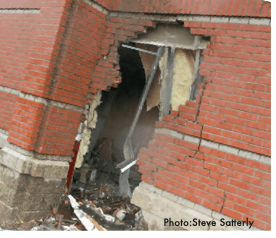
When selecting your best possible shelter area, make sure there are at least two walls between it and the outside.
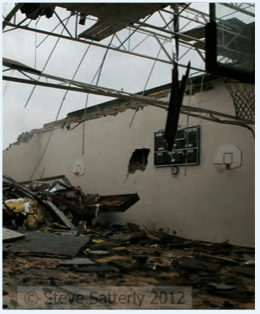
For example, the photo above shows a wall that was struck by a 15-foot-long tree trunk (which landed on the teacher’s desk). Had anyone been sheltering there, they would have been buried under brick, masonry, drywall, and other construction materials. At Henryville High School, an exterior wall of a courtyard collapsed into a classroom. The hallway inside that classroom remained structurally sound, although a bank of lockers was knocked off its mount by the collapse.
(Photo: Stephen Satterly)
Plan for Students With Special Needs
Students with special needs should be factored into your planning. Not only do you need more space for wheelchair-bound students, but remember that many students with special needs do not react well to change, and an extreme-wind event will create major changes. Remember that the time to plan for their needs is before you need to meet those needs.
Equip Your Shelter Areas
You will need emergency equipment for your shelter areas. FEMA recommends one flashlight per 10 occupants and a first-aid kit. They also recommend a NOAA weather radio and a radio that can pick up commercial stations. An extra supply of batteries is recommended, as is a device that can produce a piercing sound without power, such as an air horn, used to signal rescue workers if you get trapped in the shelter.
You should have a communications device other than a landline phone. After a tornado, cellphone coverage may be spotty, although SMS messages may often work even if cell phones don’t.
I hope that you never have to use any of this. Having survived an EF3 tornado that tore utilities off the roof of my school in 2002, I can say that it was not a fun time. What would have made it worse is if we were not prepared.
Preparedness can make all the difference between a natural disaster and a tragedy.
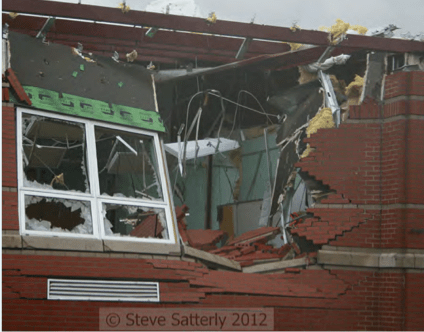
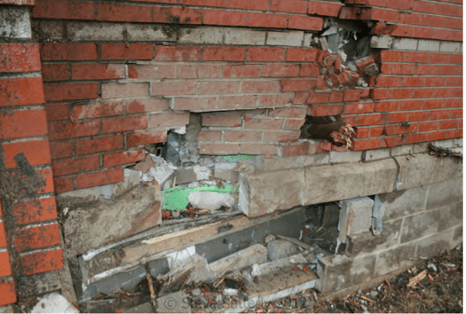
of Henryville Elementary School, on the south
side. This was one of the last remaining
classrooms left on the second floor on the east
end of the school. (Photo: Stephen Satterly)
 Stephen C. Satterly, II - Author
Leave a comment